Zika fever: Difference between revisions
CSV import |
CSV import |
||
| Line 20: | Line 20: | ||
{{stub}} | {{stub}} | ||
<gallery> | |||
File:Alexius_Salvador_Zika-Virus.jpg|Zika fever | |||
File:Zika.Virus.Rash.Arm.2014.jpg|Zika virus rash on arm | |||
File:Microcephaly-comparison-500px.jpg|Comparison showing microcephaly | |||
File:CDC_Zika_active_transmission_map_Sept_2016.jpg|CDC Zika active transmission map September 2016 | |||
File:CDC_map_of_active_Zika_virus_transmission.jpg|CDC map of active Zika virus transmission | |||
File:Videoconferência_na_Sala_Nacional_de_Coordenação_e_Controle_para_Enfrentamento_da_dengue,_chikungunya_e_Zika_vírus,_em_Brasília._(24576476372).jpg|Coordination and control meeting for dengue, chikungunya, and Zika virus in Brasília | |||
</gallery> | |||
Latest revision as of 11:31, 18 February 2025
Zero stroke is a term used in medicine to describe a stroke that presents with symptoms, but where no permanent damage can be found on subsequent imaging.
Definition[edit]
The term "zero stroke" is used to describe a situation where a patient presents with symptoms of a stroke, such as weakness, numbness, or difficulty speaking, but subsequent imaging tests, such as a CT scan or MRI, do not show any evidence of a stroke. This can be confusing for both the patient and the healthcare provider, as the symptoms are real and often quite severe, but the usual evidence of a stroke is not present.
Causes[edit]
There are several possible causes for a zero stroke. It could be that the stroke was so small that it did not show up on the imaging tests. Alternatively, the symptoms could be due to a transient ischemic attack (TIA), also known as a mini-stroke, which does not cause permanent damage and therefore would not show up on an imaging test. Another possibility is that the symptoms are due to a migraine, which can sometimes mimic the symptoms of a stroke.
Treatment[edit]
The treatment for a zero stroke will depend on the underlying cause. If the cause is a small stroke or TIA, the treatment will likely involve measures to prevent a future stroke, such as medication to reduce clotting, lifestyle changes to reduce risk factors, and possibly surgery to remove any blockages in the blood vessels. If the cause is a migraine, the treatment will focus on managing the migraine symptoms and preventing future migraines.
See also[edit]
 | |
|---|---|
 |
 |
-
 Zika fever
 -
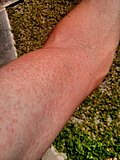 Zika virus rash on arm
 -
 Comparison showing microcephaly
 -
 CDC Zika active transmission map September 2016
 -
 CDC map of active Zika virus transmission
 -
 Coordination and control meeting for dengue, chikungunya, and Zika virus in Brasília


.jpg)
