Photon: Difference between revisions
CSV import |
CSV import |
||
| (One intermediate revision by the same user not shown) | |||
| Line 1: | Line 1: | ||
{{short description|Elementary particle or quantum of light}} | |||
A '''photon''' is a type of elementary particle, the quantum of the electromagnetic field including electromagnetic radiation such as light, and the force carrier for the electromagnetic force (even when static via virtual particles). The photon has zero rest mass and always moves at the speed of light within a vacuum. | A '''photon''' is a type of elementary particle, the quantum of the electromagnetic field including electromagnetic radiation such as light, and the force carrier for the electromagnetic force (even when static via virtual particles). The photon has zero rest mass and always moves at the speed of light within a vacuum. | ||
| Line 18: | Line 17: | ||
Photons have many applications in technology. These include night vision goggles, spectroscopy, and highly accurate atomic clocks. | Photons have many applications in technology. These include night vision goggles, spectroscopy, and highly accurate atomic clocks. | ||
== See also == | == See also == | ||
* [[Quantum mechanics]] | * [[Quantum mechanics]] | ||
| Line 25: | Line 23: | ||
* [[Elementary particle]] | * [[Elementary particle]] | ||
* [[Electromagnetic force]] | * [[Electromagnetic force]] | ||
[[Category:Elementary particles]] | [[Category:Elementary particles]] | ||
[[Category:Quantum mechanics]] | [[Category:Quantum mechanics]] | ||
[[Category:Electromagnetism]] | [[Category:Electromagnetism]] | ||
[[Category:Light]] | [[Category:Light]] | ||
{{stb}} | |||
{{ | <gallery> | ||
File:Photoelectric_effect_in_a_solid_-_diagram.svg|Photoelectric effect in a solid - diagram | |||
File:1926_Gilbert_N._Lewis_letter_which_brought_the_word_"photon"_into_common_usage.svg|1926 Gilbert N. Lewis letter which brought the word "photon" into common usage | |||
File:Light_cone_colour.svg|Light cone colour | |||
File:Young_Diffraction.png|Young Diffraction | |||
File:Light-wave.svg|Light wave | |||
File:Bohr-atom-PAR.svg|Bohr atom PAR | |||
File:Stimulatedemission.png|Stimulated emission | |||
File:VisibleEmrWavelengths.svg|Visible EMR Wavelengths | |||
File:Electron-scattering.svg|Electron scattering | |||
</gallery> | |||
Latest revision as of 21:11, 23 February 2025
Elementary particle or quantum of light
A photon is a type of elementary particle, the quantum of the electromagnetic field including electromagnetic radiation such as light, and the force carrier for the electromagnetic force (even when static via virtual particles). The photon has zero rest mass and always moves at the speed of light within a vacuum.
Properties[edit]
Photons are massless, so they always move at the speed of light in a vacuum, 299792458 meters per second. The photon is also responsible for carrying electromagnetic force, one of the four fundamental forces.
Wave–particle duality[edit]
Like all elementary particles, photons are currently best explained by quantum mechanics and exhibit wave–particle duality, exhibiting properties of both waves and particles.
Physical properties[edit]
Photons are massless, so they cannot slow down; they move at the speed of light in a vacuum. This speed is a constant of nature and is one of the fundamental constants in the theory of relativity.
Applications[edit]
Photons have many applications in technology. These include night vision goggles, spectroscopy, and highly accurate atomic clocks.
See also[edit]
- Quantum mechanics
- Electromagnetic radiation
- Speed of light
- Elementary particle
- Electromagnetic force
| This article is a stub. You can help WikiMD by registering to expand it. |
-
 Photoelectric effect in a solid - diagram
 -
 1926 Gilbert N. Lewis letter which brought the word "photon" into common usage
 -
 Light cone colour
 -
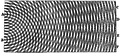 Young Diffraction
 -
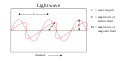 Light wave
 -
 Bohr atom PAR
 -
 Stimulated emission
 -
 Visible EMR Wavelengths
 -
 Electron scattering


