Stork: Difference between revisions
CSV import |
CSV import |
||
| (2 intermediate revisions by the same user not shown) | |||
| Line 1: | Line 1: | ||
{{Short description|An overview of the stork, a large wading bird.}} | |||
Storks | ==Stork== | ||
The '''stork''' is a large, long-legged, long-necked wading bird with a long, stout bill. Storks belong to the family [[Ciconiidae]], and they are known for their migratory behavior and distinctive appearance. These birds are found across many parts of the world, particularly in temperate and tropical regions. | |||
[[File:White Stork.jpg|thumb|right|A white stork in flight.]] | |||
Storks | ==Description== | ||
Storks are large birds, with some species reaching a height of over 1.5 meters. They have long legs adapted for wading through water, and their long necks and bills are ideal for catching prey. Storks are generally silent birds, lacking the syrinx muscles that allow other birds to sing. Instead, they communicate through bill-clattering, a behavior often observed during courtship. | |||
==Habitat== | |||
Storks are typically found in wetlands, marshes, and other areas with abundant water sources. They build large nests, often in trees or on man-made structures such as chimneys and rooftops. These nests are reused year after year and can become quite large over time. | |||
==Diet== | |||
Storks are carnivorous and primarily feed on fish, frogs, insects, and small mammals. They hunt by wading through shallow water and using their long bills to catch prey. Some species, like the [[Marabou stork]], are also known to scavenge. | |||
==Behavior== | |||
Storks are migratory birds, with many species traveling long distances between their breeding and wintering grounds. For example, the [[White stork]] migrates from Europe to Africa each year. Storks are also known for their monogamous breeding pairs, often returning to the same nesting sites with the same partners each year. | |||
[[File:Stork Nest.jpg|thumb|left|A stork nest on a rooftop.]] | |||
==Cultural Significance== | |||
Storks have been featured in various cultural myths and stories. In European folklore, storks are often associated with delivering babies, a myth that has persisted into modern times. This association is thought to have originated from the stork's migratory patterns, which coincide with the arrival of spring and new life. | |||
==Conservation== | |||
While some stork species are abundant, others are threatened by habitat loss and environmental changes. Conservation efforts are in place to protect these birds and their habitats, ensuring that stork populations remain stable. | |||
==Related pages== | |||
* [[Heron]] | |||
* [[Ibis]] | |||
* [[Crane (bird)]] | |||
* [[Wetland]] | |||
[[Category:Ciconiidae]] | |||
[[Category:Birds]] | [[Category:Birds]] | ||
[[Category: | [[Category:Wading birds]] | ||
<gallery> | |||
File:Ringed white stork.jpg|Ringed White Stork | |||
File:Dvorac Bisag - roda.jpg|Stork at Dvorac Bisag | |||
File:Yellow-billed Stork (Mycteria ibis) (12011503884).jpg|Yellow-billed Stork | |||
File:Lesser Adjutant (Leptoptilos javanicus) - Flickr - Lip Kee (4).jpg|Lesser Adjutant | |||
File:Marabou stork at Etosha National Park, Namibia.jpg|Marabou Stork at Etosha National Park | |||
File:Abdim's Stork (Ciconia abdimii) (7011390701).jpg|Abdim's Stork | |||
File:African openbill, Anastomus lamelligerus, Chobe National Park, Botswana (32390774275).jpg|African Openbill | |||
File:Plate facing page 52, An Argosy of Fables.jpg|Stork from An Argosy of Fables | |||
</gallery> | |||
Latest revision as of 01:25, 20 February 2025
An overview of the stork, a large wading bird.
Stork[edit]
The stork is a large, long-legged, long-necked wading bird with a long, stout bill. Storks belong to the family Ciconiidae, and they are known for their migratory behavior and distinctive appearance. These birds are found across many parts of the world, particularly in temperate and tropical regions.

Description[edit]
Storks are large birds, with some species reaching a height of over 1.5 meters. They have long legs adapted for wading through water, and their long necks and bills are ideal for catching prey. Storks are generally silent birds, lacking the syrinx muscles that allow other birds to sing. Instead, they communicate through bill-clattering, a behavior often observed during courtship.
Habitat[edit]
Storks are typically found in wetlands, marshes, and other areas with abundant water sources. They build large nests, often in trees or on man-made structures such as chimneys and rooftops. These nests are reused year after year and can become quite large over time.
Diet[edit]
Storks are carnivorous and primarily feed on fish, frogs, insects, and small mammals. They hunt by wading through shallow water and using their long bills to catch prey. Some species, like the Marabou stork, are also known to scavenge.
Behavior[edit]
Storks are migratory birds, with many species traveling long distances between their breeding and wintering grounds. For example, the White stork migrates from Europe to Africa each year. Storks are also known for their monogamous breeding pairs, often returning to the same nesting sites with the same partners each year.

Cultural Significance[edit]
Storks have been featured in various cultural myths and stories. In European folklore, storks are often associated with delivering babies, a myth that has persisted into modern times. This association is thought to have originated from the stork's migratory patterns, which coincide with the arrival of spring and new life.
Conservation[edit]
While some stork species are abundant, others are threatened by habitat loss and environmental changes. Conservation efforts are in place to protect these birds and their habitats, ensuring that stork populations remain stable.
Related pages[edit]
-
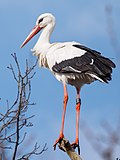 Ringed White Stork
 -
 Stork at Dvorac Bisag
 -
 Yellow-billed Stork
 -
 Lesser Adjutant
 -
 Marabou Stork at Etosha National Park
 -
 Abdim's Stork
 -
 African Openbill
 -
 Stork from An Argosy of Fables


_(12011503884).jpg)
_-_Flickr_-_Lip_Kee_(4).jpg)

_(7011390701).jpg)
.jpg)

