Sympathetic nervous system: Difference between revisions
CSV import |
CSV import |
||
| Line 31: | Line 31: | ||
{{stub}} | {{stub}} | ||
<gallery> | |||
File:Blausen_0838_Sympathetic_Innervation.png|Sympathetic innervation diagram | |||
File:Gray838.png|Diagram of the sympathetic nervous system | |||
File:Gray799.svg|Sympathetic nervous system pathways | |||
File:Sympathetic_Nervous_System.jpg|Sympathetic nervous system | |||
</gallery> | |||
Latest revision as of 04:35, 18 February 2025
Sympathetic Nervous System
The Sympathetic nervous system (SNS) is one of the two main divisions of the autonomic nervous system (ANS), the other being the parasympathetic nervous system (PNS). The autonomic nervous system functions to regulate the body's unconscious actions. The sympathetic nervous system's primary process is to stimulate the body's fight-or-flight response. It is, however, constantly active at a basic level to maintain homeostasis.
Structure[edit]
The sympathetic nervous system is part of the autonomic nervous system, which also includes the parasympathetic nervous system and the enteric nervous system. The sympathetic nervous system is responsible for up- and down-regulating many homeostatic mechanisms in living organisms.
Function[edit]
The sympathetic nervous system is responsible for the body's response to stress or danger. It increases heart rate, blood pressure, and blood glucose levels; dilates the pupils; and slows digestion. It also has important roles in the control of most of the body's internal organs.
Clinical significance[edit]
Dysfunction of the sympathetic nervous system can lead to a variety of clinical conditions, such as hypertension, heart failure, and anxiety disorders.
See also[edit]
References[edit]
<references />
External links[edit]
 |
 |
-
Sympathetic innervation diagram
-
Diagram of the sympathetic nervous system
-
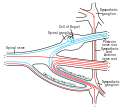 Sympathetic nervous system pathways
 -
Sympathetic nervous system


