Sponge: Difference between revisions
CSV import |
CSV import |
||
| Line 39: | Line 39: | ||
{{stub}} | {{stub}} | ||
<gallery> | |||
File:Reef3859 - Flickr - NOAA Photo Library.jpg|Sponge | |||
File:Choanoflagellate and choanocyte.png|Choanoflagellate and choanocyte | |||
File:Tide pools sponge.jpg|Tide pools sponge | |||
File:Aphrocallistes vastus.jpg|Aphrocallistes vastus | |||
File:Sea sponge diagram.svg|Sea sponge diagram | |||
File:Porifera calcifying 01.png|Porifera calcifying | |||
File:Spongia officinalis.jpg|Spongia officinalis | |||
File:Venus Flower Basket.jpg|Venus Flower Basket | |||
File:Chondrocladia lampadiglobus.jpg|Chondrocladia lampadiglobus | |||
File:Spongilla lacustris.jpg|Spongilla lacustris | |||
File:Euplectella aspergillum (cropped).jpg|Euplectella aspergillum | |||
File:BoredEncrustedShell.JPG|Bored encrusted shell | |||
</gallery> | |||
Latest revision as of 01:18, 20 February 2025
Sponge
A Sponge is a simple multicellular organism that belongs to the phylum Porifera. They are primarily marine animals, although some species are found in freshwater environments. Sponges are known for their porous bodies and the ability to filter feed by drawing water in through their pores.
Anatomy[edit]
Sponges have a simple body structure, lacking true tissues and organs. They are composed of three layers: the outer epidermis, the middle mesohyl, and the inner choanocyte layer. The body is perforated by a series of pores, canals, and chambers that allow water to flow through and nutrients to be extracted.
Reproduction[edit]
Sponges reproduce both sexually and asexually. In sexual reproduction, sponges produce eggs and sperm, and in many species, the sperm is released into the water and captured by other sponges, leading to fertilization. Asexual reproduction occurs through budding, fragmentation, or the production of gemmules.
Ecology[edit]
Sponges play a significant role in marine ecosystems. They serve as habitat for a variety of organisms and contribute to the recycling of nutrients in the water column. Some species of sponges are also known to form symbiotic relationships with other organisms, including bacteria, algae, and various invertebrates.
Human use[edit]
Humans have used sponges for various purposes throughout history. The soft, absorbent bodies of certain sponge species have been used for cleaning and bathing, while other species have been used in the production of natural remedies.
See also[edit]
References[edit]
<references />
External links[edit]
 | |
|---|---|
 |
 |
-
 Sponge
 -
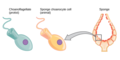 Choanoflagellate and choanocyte
 -
 Tide pools sponge
 -
 Aphrocallistes vastus
 -
 Sea sponge diagram
 -
 Porifera calcifying
 -
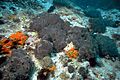 Spongia officinalis
 -
 Venus Flower Basket
 -
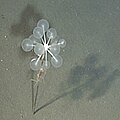 Chondrocladia lampadiglobus
 -
 Spongilla lacustris
 -
 Euplectella aspergillum
 -
 Bored encrusted shell


.jpg)

