Western culture: Difference between revisions
CSV import |
CSV import |
||
| Line 30: | Line 30: | ||
{{stub}} | {{stub}} | ||
== Western_culture == | |||
<gallery> | |||
File:Da_Vinci_Vitruve_Luc_Viatour.jpg|Da Vinci Vitruvian Man | |||
File:Plato_Pio-Clemetino_Inv305.jpg|Plato Bust | |||
File:Alejandro_Magno,_Alexander_The_Great_Bust_Alexander_BM_1857_(cropped).jpg|Alexander The Great Bust | |||
File:Maison_Carree_in_Nimes_(16).jpg|Maison Carrée in Nîmes | |||
File:Roman_Empire_Trajan_117AD.png|Roman Empire Trajan 117 AD | |||
File:Roman_Empire_330_CE.png|Roman Empire 330 CE | |||
File:Sanvitale03.jpg|San Vitale | |||
File:Slovakia_region_Spis_33.jpg|Spiš Region Slovakia | |||
File:Vezelay_WLM2016_La_basilique_Sainte-Marie-Madeleine_(3).jpg|Vézelay Basilica | |||
File:Notre_Dame_de_Paris_2013-07-24.jpg|Notre Dame de Paris | |||
File:Carlo_Crivelli_007.jpg|Carlo Crivelli Painting | |||
File:Landing_of_Columbus_(2)_(cropped).jpg|Landing of Columbus | |||
</gallery> | |||
Latest revision as of 21:24, 23 February 2025
Western culture, also known as Western civilization, is a term used broadly to refer to a heritage of social norms, ethical values, traditional customs, belief systems, political systems, and specific artifacts and technologies that have some origin or association with Europe. The term also applies beyond Europe to countries and cultures whose histories are strongly connected to Europe by immigration, colonization, or influence.
Origins[edit]
Western culture is generally linked to the classical antiquity period, influenced by the ancient Greeks, and more specifically the impact of the Roman Empire. The foundations of Western culture are often associated with the Greco-Roman world, with the understanding that it was ultimately transformed significantly by the influence of Christianity during the Middle Ages.
Influence[edit]
Western culture continued to develop with the Christianization of Europe during the Middle Ages, the reform and modernization triggered by the Renaissance, and with globalization by successive European empires, that spread European ways of life and European educational methods around the world between the 16th and 20th centuries.
Characteristics[edit]
Western culture has its roots in the Classical Period of the Greco-Roman era and the rise of Christianity in the 14th century. Other drivers of Western culture include Latin, Celtic, Germanic and Hellenic ethnic and linguistic groups. Today, the influences of Western culture can be seen in almost every country in the world.
Criticism[edit]
Western culture has been criticized for its materialism, rationalism, and individualism. It has also been criticized for its alleged imperialism and cultural hegemony.
See also[edit]
References[edit]
<references />
External links[edit]
 | |
|---|---|
 |
 |
Western_culture[edit]
-
 Da Vinci Vitruvian Man
 -
 Plato Bust
 -
 Alexander The Great Bust
 -
 Maison Carrée in Nîmes
 -
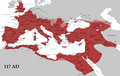 Roman Empire Trajan 117 AD
 -
 Roman Empire 330 CE
 -
 San Vitale
 -
 Spiš Region Slovakia
 -
 Vézelay Basilica
 -
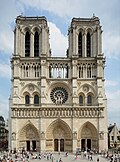 Notre Dame de Paris
 -
 Carlo Crivelli Painting
 -
 Landing of Columbus


.jpg)
.jpg)


.jpg)


_(cropped).jpg)
