Trombiculidae: Difference between revisions
CSV import Tags: mobile edit mobile web edit |
CSV import |
||
| (One intermediate revision by the same user not shown) | |||
| Line 1: | Line 1: | ||
'''Trombiculidae''' | == Trombiculidae == | ||
[[File:Trombicula-mite-larva-with_stylostome-2.jpg|thumb|right|Trombicula mite larva with stylostome]] | |||
'''Trombiculidae''', commonly known as chiggers, are a family of mites in the order [[Trombidiformes]]. These mites are known for their larval stage, which can cause intense itching and dermatitis in humans and animals. The larvae are parasitic, feeding on the skin cells of their hosts. | |||
== Description == | == Description == | ||
Trombiculidae are | |||
[[File:Trombicula-mite-adult.JPG|thumb|right|Adult Trombicula mite]] | |||
Trombiculidae mites are small, with adults measuring about 1 to 2 mm in length. The larvae, which are the only parasitic stage, are even smaller, typically less than 0.3 mm. They are usually red or orange in color, which makes them visible to the naked eye. The larvae have six legs, while the nymphs and adults have eight legs. | |||
== Life Cycle == | == Life Cycle == | ||
== | [[File:Harvest_mite_cycle.svg|thumb|right|Life cycle of the harvest mite]] | ||
Trombiculidae | |||
The life cycle of Trombiculidae includes four stages: egg, larva, nymph, and adult. The eggs are laid in the soil, and upon hatching, the larvae seek out a host to feed on. After feeding, the larvae drop off the host and develop into nymphs, which eventually mature into adults. The adults are free-living and feed on small arthropods and their eggs. | |||
== Parasitic Behavior == | |||
[[File:Trombiculid_mite_larvae_attached_to_human_skin.jpg|thumb|right|Trombiculid mite larvae attached to human skin]] | |||
The larval stage of Trombiculidae is parasitic. The larvae attach to the skin of their host and inject digestive enzymes that break down skin cells. They do not burrow into the skin but remain on the surface, feeding through a stylostome, a tube-like structure formed by the host's skin in response to the mite's saliva. | |||
== Effects on Humans == | |||
[[File:Chigger_bite.svg|thumb|right|Illustration of a chigger bite]] | |||
Chigger bites can cause intense itching and dermatitis, known as trombiculosis. The itching is due to the body's allergic reaction to the mite's saliva. The bites often appear as red, raised bumps and can be extremely itchy. Scratching can lead to secondary infections. | |||
== Prevention and Treatment == | == Prevention and Treatment == | ||
To prevent chigger bites, it is recommended to avoid walking through tall grass and brush where chiggers are common. Wearing long sleeves and pants, and using insect repellent can also help. If bitten, over-the-counter anti-itch creams and antihistamines can provide relief. Keeping the affected area clean can prevent infection. | |||
== Related Pages == | |||
* [[ | * [[Mite]] | ||
* [[ | * [[Parasitism]] | ||
* [[ | * [[Dermatitis]] | ||
[[Category:Trombiculidae]] | |||
[[Category:Parasitic arthropods]] | |||
<gallery> | |||
File:Trombicula-mite-larva-with_stylostome-2.jpg|Trombicula mite larva with stylostome | |||
File:Harvest_mite_cycle.svg|Harvest mite life cycle | |||
File:Chigger_bite.svg|Chigger bite illustration | |||
File:Trombicula-mite-adult.JPG|Adult Trombicula mite | |||
File:TrombiculosisSores.jpg|Trombiculosis sores | |||
File:Trombiculid_mite_larvae_attached_to_human_skin.jpg|Trombiculid mite larvae attached to human skin | |||
</gallery> | |||
Latest revision as of 11:16, 18 February 2025
Trombiculidae[edit]

Trombiculidae, commonly known as chiggers, are a family of mites in the order Trombidiformes. These mites are known for their larval stage, which can cause intense itching and dermatitis in humans and animals. The larvae are parasitic, feeding on the skin cells of their hosts.
Description[edit]

Trombiculidae mites are small, with adults measuring about 1 to 2 mm in length. The larvae, which are the only parasitic stage, are even smaller, typically less than 0.3 mm. They are usually red or orange in color, which makes them visible to the naked eye. The larvae have six legs, while the nymphs and adults have eight legs.
Life Cycle[edit]

The life cycle of Trombiculidae includes four stages: egg, larva, nymph, and adult. The eggs are laid in the soil, and upon hatching, the larvae seek out a host to feed on. After feeding, the larvae drop off the host and develop into nymphs, which eventually mature into adults. The adults are free-living and feed on small arthropods and their eggs.
Parasitic Behavior[edit]

The larval stage of Trombiculidae is parasitic. The larvae attach to the skin of their host and inject digestive enzymes that break down skin cells. They do not burrow into the skin but remain on the surface, feeding through a stylostome, a tube-like structure formed by the host's skin in response to the mite's saliva.
Effects on Humans[edit]

Chigger bites can cause intense itching and dermatitis, known as trombiculosis. The itching is due to the body's allergic reaction to the mite's saliva. The bites often appear as red, raised bumps and can be extremely itchy. Scratching can lead to secondary infections.
Prevention and Treatment[edit]
To prevent chigger bites, it is recommended to avoid walking through tall grass and brush where chiggers are common. Wearing long sleeves and pants, and using insect repellent can also help. If bitten, over-the-counter anti-itch creams and antihistamines can provide relief. Keeping the affected area clean can prevent infection.
Related Pages[edit]
-
 Trombicula mite larva with stylostome
 -
 Harvest mite life cycle
 -
 Chigger bite illustration
 -
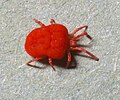 Adult Trombicula mite
 -
 Trombiculosis sores
 -
 Trombiculid mite larvae attached to human skin

