Simmering: Difference between revisions
CSV import Tags: mobile edit mobile web edit |
CSV import |
||
| Line 22: | Line 22: | ||
{{stub}} | {{stub}} | ||
{{dictionary-stub1}} | {{dictionary-stub1}} | ||
<gallery> | |||
File:SopaAlbondigasPot.JPG|Simmering | |||
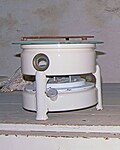
File:Molen_Emmamolen_Nieuwkuijk,_petroleumstel.jpg|Simmering | |||
</gallery> | |||
Latest revision as of 01:55, 18 February 2025
Simmering is a food preparation technique by which foods are cooked in hot liquids kept just below the boiling point of water (which is 100 °C or 212 °F at average sea level air pressure), but higher than poaching temperature. To keep a pot simmering, one brings it to a boil and then reduces the heat to a level that just barely keeps the water bubbling.
Process[edit]
The process of simmering involves heating a liquid to a temperature between 85–95 °C (185–203 °F), below its boiling point, and then maintaining that temperature. This is typically done by adjusting the heat source to a lower setting. The liquid should be kept at a steady temperature, with small bubbles rising to the surface at a slow, steady rate.
Simmering is often used to cook proteins, such as meats and poultry, in a flavorful liquid or to reduce sauces. It is also used in the preparation of soups, stews, and other dishes that require long, slow cooking.
Advantages[edit]
Simmering has several advantages over other cooking methods. It allows for the slow and even cooking of food, which can enhance flavor and texture. It also helps to tenderize tougher cuts of meat and to infuse the food with the flavors of the cooking liquid.
See also[edit]
References[edit]
<references />
 | This medical article is a stub. You can help WikiMD by expanding the page. |
-
 Simmering
 -
 Simmering


