Post-translational modification: Difference between revisions
From Food & Medicine Encyclopedia
CSV import |
CSV import |
||
| Line 36: | Line 36: | ||
{{stub}} | {{stub}} | ||
{{dictionary-stub1}} | {{dictionary-stub1}} | ||
<gallery> | |||
File:Insulin_path.svg|Insulin signaling pathway | |||
File:GeneticCode22.svg|Genetic code chart | |||
File:Image_for_Wiki_2.jpg|Post-translational modification | |||
File:Image_for_Wiki_1.jpg|Post-translational modification | |||
</gallery> | |||
Latest revision as of 04:33, 18 February 2025
Post-translational modification (PTM) refers to the covalent and generally enzymatic modification of proteins following protein biosynthesis. Proteins are synthesized by ribosomes translating mRNA into polypeptide chains, which may then undergo PTM to form the mature protein product.
Types of Post-translational modifications[edit]
There are many types of post-translational modifications. Some of the most common types include:
- Phosphorylation: This is the process where a phosphate group is added to a protein by a protein kinase. This modification can activate or deactivate the function of the protein.
- Acetylation: This is the process where an acetyl group is added to a protein. This modification can change the protein's function and localization.
- Methylation: This is the process where a methyl group is added to a protein. This modification can affect the protein's interaction with DNA and other proteins.
- Glycosylation: This is the process where a carbohydrate is added to a protein. This modification can affect the protein's stability and cellular localization.
- Ubiquitination: This is the process where a ubiquitin protein is added to a protein. This modification can signal for the protein's degradation.
Functions of Post-translational modifications[edit]
Post-translational modifications can have a wide range of functions. Some of the most common functions include:
- Regulation of protein function: Many post-translational modifications can activate or deactivate the function of the protein.
- Protein degradation: Some post-translational modifications can signal for the protein to be degraded.
- Cellular localization: Some post-translational modifications can change the localization of the protein within the cell.
- Protein-protein interactions: Some post-translational modifications can affect the protein's ability to interact with other proteins.
See also[edit]
 | |
|---|---|
 |
 |
| This medical article is a stub. You can help Wikipedia by adding missing information. |
-
 Insulin signaling pathway
 -
 Genetic code chart
 -
 Post-translational modification
 -
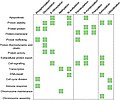 Post-translational modification


