NASA: Difference between revisions
From WikiMD's Wellness Encyclopedia
CSV import |
CSV import |
||
| Line 39: | Line 39: | ||
[[Category:Independent agencies of the United States government]] | [[Category:Independent agencies of the United States government]] | ||
{{stub}} | {{stub}} | ||
<gallery> | |||
File:NASA_logo.svg|NASA logo | |||
File:NASA_Worm_logo.svg|NASA Worm logo | |||
File:NASA_HQ_Building.jpg|NASA HQ Building | |||
File:Bell_X-1A_in_flight.jpg|Bell X-1A in flight | |||
File:Launch_of_Jupiter_C_with_Explorer_1.jpg|Launch of Jupiter C with Explorer 1 | |||
File:Launch_of_Friendship_7_-_GPN-2000-000686.jpg|Launch of Friendship 7 | |||
File:X-15_flying.jpg|X-15 flying | |||
File:S65-63188.jpg|Gemini 6A and Gemini 7 rendezvous | |||
File:Apollo_11_Launch_-_GPN-2000-000630.jpg|Apollo 11 Launch | |||
File:Buzz_salutes_the_U.S._Flag.jpg|Buzz salutes the U.S. Flag | |||
File:Apollo_CSM_lunar_orbit.jpg|Apollo CSM lunar orbit | |||
File:Viking2lander1.jpg|Viking 2 lander | |||
</gallery> | |||
Latest revision as of 21:07, 23 February 2025
NASA
The National Aeronautics and Space Administration (NASA) is an independent agency of the U.S. federal government responsible for the nation's civilian space program and for aeronautics and aerospace research.
History[edit]
NASA was created in response to the Soviet Union's October 4, 1957 launch of its first satellite, Sputnik I. The 183-pound, basketball-sized satellite orbited the earth in 98 minutes. The Sputnik shock led to the creation of NASA from the National Advisory Committee for Aeronautics and other government agencies on July 29, 1958, by the National Aeronautics and Space Act.
Programs[edit]
NASA conducts its work in four principal organizations, known as mission directorates:
- Aeronautics: Pioneers and proves new flight technologies that improve our ability to explore and which have practical applications on Earth.
- Human Exploration and Operations: Focuses on International Space Station operations and human exploration beyond low Earth orbit.
- Science: Explores the Earth, moon, Mars, and beyond; charts the best route of discovery; and reaps the benefits of Earth and space exploration for society.
- Space Technology: Rapidly develops, innovates, demonstrates, and infuses revolutionary, high-payoff technologies that enable NASA's future missions while providing economic benefit to the nation.
See also[edit]
References[edit]
<references />
External links[edit]
 | |
|---|---|
 |
 |
-
 NASA logo
 -
 NASA Worm logo
 -
 NASA HQ Building
 -
 Bell X-1A in flight
 -
 Launch of Jupiter C with Explorer 1
 -
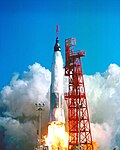 Launch of Friendship 7
 -
 X-15 flying
 -
 Gemini 6A and Gemini 7 rendezvous
 -
 Apollo 11 Launch
 -
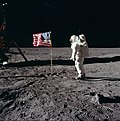 Buzz salutes the U.S. Flag
 -
 Apollo CSM lunar orbit
 -
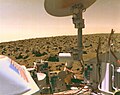 Viking 2 lander


