Mass: Difference between revisions
CSV import |
CSV import |
||
| Line 32: | Line 32: | ||
{{stub}} | {{stub}} | ||
{{dictionary-stub1}} | {{dictionary-stub1}} | ||
<gallery> | |||
File:Poids_fonte_2_kg_03_(cropped).jpg|Poids fonte 2 kg | |||
File:SI_base_unit.svg|SI base unit | |||
File:Mass_versus_weight_in_earth_and_mars.svg|Mass versus weight in earth and mars | |||
File:Apollo_15_feather_and_hammer_drop.ogv|Apollo 15 feather and hammer drop | |||
File:El_pesado_del_corazón_en_el_Papiro_de_Hunefer.jpg|El pesado del corazón en el Papiro de Hunefer | |||
File:Galileo.arp.300pix.jpg|Galileo | |||
File:Falling_ball.jpg|Falling ball | |||
File:GodfreyKneller-IsaacNewton-1689.jpg|Isaac Newton | |||
File:Newton_Cannon.svg|Newton Cannon | |||
File:Universal_gravitational_mass.jpg|Universal gravitational mass | |||
File:Cavendish_Experiment.png|Cavendish Experiment | |||
File:Massmeter.jpg|Massmeter | |||
</gallery> | |||
Latest revision as of 21:32, 23 February 2025
Mass is a fundamental concept in physics, representing the amount of matter in an object. It is a scalar quantity, meaning it only has magnitude and no direction. Mass is typically measured in kilograms (kg) in the International System of Units (SI), but can also be measured in grams (g), pounds (lb), or other units.
Definition[edit]
In physics, mass is defined as the measure of an object's resistance to acceleration. This is known as inertia. The more mass an object has, the more force is required to change its speed or direction. This relationship is described by Newton's second law of motion, which states that the force applied to an object is equal to the mass of the object multiplied by its acceleration (F = ma).
Measurement[edit]
Mass is measured using a balance scale, which compares the mass of the object being measured to the mass of a set of known weights. This is different from measuring weight, which is the force exerted by gravity on an object. Because the force of gravity can vary depending on location, an object's weight can change, but its mass remains constant.
Types of Mass[edit]
There are several types of mass in physics, including rest mass, inertial mass, and gravitational mass. Rest mass is the mass of an object as measured when it is at rest relative to an observer. Inertial mass is the mass of an object as determined by its resistance to acceleration. Gravitational mass is the mass of an object as determined by the force of gravity it exerts on other objects.
Mass in Relativity[edit]
In Einstein's theory of relativity, mass is not always conserved. Instead, mass and energy are interchangeable, as described by the famous equation E=mc^2. This means that an object can gain or lose mass by gaining or losing energy.
See Also[edit]
 | |
|---|---|
 |
 |
-
 Poids fonte 2 kg
 -
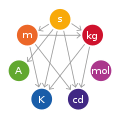 SI base unit
 -
 Mass versus weight in earth and mars
 -
 Apollo 15 feather and hammer drop
 -
 El pesado del corazón en el Papiro de Hunefer
 -
 Galileo
 -
 Falling ball
 -
 Isaac Newton
 -
 Newton Cannon
 -
 Universal gravitational mass
 -
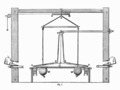 Cavendish Experiment
 -
 Massmeter
.jpg)


