Rock tripe: Difference between revisions
CSV import |
CSV import |
||
| Line 40: | Line 40: | ||
* [http://www.lichen.com/bigpix/Umvellea.html Umbilicaria vellea] | * [http://www.lichen.com/bigpix/Umvellea.html Umbilicaria vellea] | ||
{{dictionary-stub1}} | {{dictionary-stub1}} | ||
<gallery> | |||
File:Blistered_Rocktripe_(3560427638).jpg|Blistered Rocktripe | |||
File:Korean_pan_fried_mushrooms.jpg|Rock tripe | |||
File:Tripes_de_Roche.jpg|Tripes de Roche | |||
File:Hiroshige_II_-_Kishu_kumano_iwatake_tori_-_Shokoku_meisho_hyakkei.jpg|Kishu kumano iwatake tori | |||
File:Umbilicaria_havaasii_Sotlav.jpg|Umbilicaria havaasii | |||
</gallery> | |||
Latest revision as of 21:25, 20 February 2025
Rock Tripe[edit]
Rock tripe is a type of lichen that grows on rocks in various parts of the world. It is known for its ability to survive in harsh conditions and has been used as a source of food in times of scarcity.
Description[edit]
Rock tripe is a type of umbilicate lichen, which means it is attached to the rock at a single point. It has a leathery texture and can vary in color from dark brown to gray. The upper surface of the lichen is typically smooth, while the lower surface is rough and often has a white or light-colored appearance.
Habitat and Distribution[edit]
Rock tripe is found in many parts of the world, including North America, Europe, and Asia. It is typically found in mountainous regions, where it grows on rocks in exposed locations. The lichen is able to survive in harsh conditions, including extreme cold, heat, and drought.
Uses[edit]
Rock tripe has been used as a source of food in times of scarcity. It can be boiled or soaked in water to make it edible. However, it is not a preferred source of food due to its bitter taste and tough texture. In addition to its use as food, rock tripe has also been used in traditional medicine.
Species[edit]
There are several species of rock tripe, including Umbilicaria mammulata, Umbilicaria phaea, and Umbilicaria vellea. Each species has slightly different characteristics, but all are able to survive in harsh conditions.
Conservation Status[edit]
Rock tripe is not currently considered to be at risk of extinction. However, like all lichens, it is sensitive to air pollution and changes in its habitat.
See Also[edit]
References[edit]
- Lichens of North America, by Irwin M. Brodo, Sylvia Duran Sharnoff, and Stephen Sharnoff
- Field Guide to the Lichens of Great Britain and Ireland, by Mark Powell
External Links[edit]

-
 Blistered Rocktripe
 -
 Rock tripe
 -
 Tripes de Roche
 -
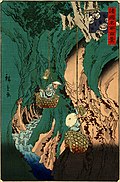 Kishu kumano iwatake tori
 -
 Umbilicaria havaasii
.jpg)


