Plankton: Difference between revisions
CSV import |
CSV import |
||
| Line 31: | Line 31: | ||
{{stub}} | {{stub}} | ||
{{dictionary-stub1}} | {{dictionary-stub1}} | ||
== Plankton == | |||
<gallery> | |||
File:Marine_microplankton.jpg|Marine microplankton | |||
File:Neuston,_Plankton,_Nekton,_Benthos.jpg|Neuston, Plankton, Nekton, Benthos | |||
File:Diatoms_through_the_microscope.jpg|Diatoms through the microscope | |||
File:hyperia.jpg|Hyperia | |||
File:Plankton_species_diversity.jpg|Plankton species diversity | |||
File:Plankton_size.png|Plankton size | |||
File:Ocean_mist_and_spray_2.jpg|Ocean mist and spray | |||
File:Jellyfish_swarm.jpg|Jellyfish swarm | |||
File:Salmonlarvakils_2.jpg|Salmon larva | |||
File:Tomopteriskils.jpg|Tomopteris | |||
File:Larva_de_phyllosoma.jpg|Larva de phyllosoma | |||
File:Diatom_Helipelta_metil.jpg|Diatom Helipelta metil | |||
</gallery> | |||
Latest revision as of 21:12, 23 February 2025
Plankton are the diverse collection of organisms found in water (or air) that are unable to propel themselves against a current (or wind). The individual organisms constituting plankton are called plankters. They provide a crucial source of food to many large aquatic organisms, such as fish and whales.
Types of Plankton[edit]
Plankton are primarily divided into broad functional (or trophic level) groups:
- Phytoplankton: These are autotrophic (self-feeding), prokaryotic or eukaryotic algae that live near the water surface where there is sufficient light to support photosynthesis. Among the more important groups are the diatoms, cyanobacteria, dinoflagellates and coccolithophores.
- Zooplankton: These are small protozoans or metazoans (e.g. crustaceans and other animals) that feed on other plankton. Some of the eggs and larvae of larger animals, such as fish, crustaceans, and annelids, are included here.
- Bacterioplankton: These include bacteria and archaea, which play an important role in remineralising organic material down the water column (note that prokaryotic phytoplankton are also bacterioplankton).
Importance of Plankton[edit]
Plankton are the foundation of the ocean food chain. They are crucial to the survival of most of the planet's aquatic life. Without plankton, the oceans would be devoid of fish and other larger marine life.
Threats to Plankton[edit]
Changes in the ocean environment, such as warming waters and ocean acidification, can affect the distribution and makeup of plankton communities. This can have a knock-on effect on the larger animals that rely on plankton for their survival.
See Also[edit]
 | |
|---|---|
 |
 |
| This medical article is a stub. You can help Wikipedia by adding missing information. |
Plankton[edit]
-
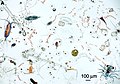 Marine microplankton
 -
 Neuston, Plankton, Nekton, Benthos
 -
 Diatoms through the microscope
 -
 Hyperia
 -
 Plankton species diversity
 -
 Plankton size
 -
 Ocean mist and spray
 -
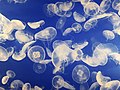 Jellyfish swarm
 -
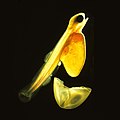 Salmon larva
 -
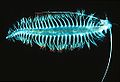 Tomopteris
 -
 Larva de phyllosoma
 -
 Diatom Helipelta metil


