Great Rift Valley: Difference between revisions
CSV import |
CSV import |
||
| Line 24: | Line 24: | ||
{{stub}} | {{stub}} | ||
<gallery> | |||
File:MapGreatRiftValley.png|Map of the Great Rift Valley | |||
File:Great_rift_valley.jpg|Great Rift Valley landscape | |||
File:Great_Rift_Valley_map-en.svg|Map of the Great Rift Valley in English | |||
File:Ocean-birth.svg|Illustration of ocean birth in the Great Rift Valley | |||
File:Graben_Afar_ASTER_20020327.jpg|Graben in the Afar region | |||
File:Great_Rift_Valley.png|Great Rift Valley | |||
File:EAfrica.png|Map of East Africa | |||
File:Cool_lava_in_Africa's_Great_Rift_Valley.jpg|Cool lava in Africa's Great Rift Valley | |||
</gallery> | |||
Latest revision as of 11:18, 18 February 2025
Great Rift Valley is a geographical and geological feature running north to south for around 4,000 miles (6,400 kilometers), from northern Syria to central Mozambique in East Africa. It is a complex of rifts, some of which are currently active, and some of which are ancient. The rifts are associated with a number of distinct tectonic plates.
Geography[edit]
The Great Rift Valley varies in width from 30-100 km. The depth of the valley also varies, with the deepest point being at Lake Tanganyika, which is approximately 1,470 meters deep. The valley is bordered by escarpments to the east and west.
Geology[edit]
The Great Rift Valley is part of an intra-continental ridge system that runs through Kenya from north to south. It is part of the Gregory Rift, the eastern branch of the East African Rift, which starts in Tanzania to the south and continues northward into Ethiopia.
Flora and Fauna[edit]
The Great Rift Valley is home to a diverse range of flora and fauna. The valley's lakes, such as Lake Nakuru, are known for their populations of flamingos. The valley also hosts a variety of wildlife, including elephants, lions, giraffes, and numerous species of birds.
Human History[edit]
The Great Rift Valley has been a significant site for human evolution and development. The Olduvai Gorge, located in the eastern branch of the rift in Tanzania, has yielded fossils of early hominids that have been instrumental in the study of human evolution.
See Also[edit]
 | |
|---|---|
 |
 |
-
 Map of the Great Rift Valley
 -
 Great Rift Valley landscape
 -
 Map of the Great Rift Valley in English
 -
 Illustration of ocean birth in the Great Rift Valley
 -
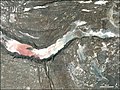 Graben in the Afar region
 -
 Great Rift Valley
 -
 Map of East Africa
 -
 Cool lava in Africa's Great Rift Valley


