Train: Difference between revisions
CSV import Tags: mobile edit mobile web edit |
CSV import |
||
| (One intermediate revision by the same user not shown) | |||
| Line 1: | Line 1: | ||
Train | |||
{{ | |||
A '''train''' is a form of rail transport consisting of a series of connected vehicles that generally run along a rail track to transport cargo or passengers. The word "train" comes from the Old French "trahiner," derived from the Latin "trahere" meaning "to pull" or "to draw". | |||
==History== | |||
The history of trains dates back to the early 19th century with the development of the steam locomotive. The first full-scale working railway steam locomotive was built in the United Kingdom in 1804 by [[Richard Trevithick]]. The first public railway to use steam locomotives was the [[Stockton and Darlington Railway]], opened in 1825. | |||
==Types of Trains== | |||
Trains can be classified into several types based on their purpose and the technology they use: | |||
===Passenger Trains=== | |||
Passenger trains are designed to transport people. They can be further divided into several categories: | |||
* '''Intercity Trains''': These trains connect cities and are often high-speed, such as the [[TGV]] in France and the [[Shinkansen]] in Japan. | |||
* '''Commuter Trains''': These trains operate over shorter distances and are designed to bring passengers from suburban areas to city centers. | |||
* '''Metro Trains''': Also known as subways or undergrounds, these trains operate within urban areas and are designed for high-capacity, frequent service. | |||
===Freight Trains=== | |||
Freight trains are used to transport goods and materials. They are typically longer and heavier than passenger trains and can carry a wide variety of cargo, from coal and steel to consumer goods. | |||
===High-Speed Trains=== | |||
High-speed trains are designed to operate at much higher speeds than traditional trains. They often run on dedicated tracks and are used for long-distance travel. Examples include the [[Eurostar]] and the [[Acela Express]]. | |||
==Technology== | |||
The technology behind trains has evolved significantly since their inception. Modern trains can be powered by steam, diesel, or electricity. | |||
===Steam Trains=== | |||
Steam trains were the first type of trains and were powered by steam engines. They have largely been replaced by more efficient forms of propulsion. | |||
===Diesel Trains=== | |||
Diesel trains use diesel engines to generate electricity or directly power the train. They are commonly used in areas where electrification of tracks is not feasible. | |||
===Electric Trains=== | |||
Electric trains are powered by electricity from overhead lines or an electrified third rail. They are more environmentally friendly and are used extensively in urban and high-speed rail systems. | |||
==Infrastructure== | |||
Trains run on tracks that consist of two parallel steel rails, supported by sleepers (or ties) and ballast. The infrastructure also includes stations, signaling systems, and maintenance facilities. | |||
==Safety== | |||
Safety is a critical aspect of train operations. Modern trains are equipped with advanced signaling systems, automatic train control, and other safety features to prevent accidents. | |||
==Also see== | |||
* [[Rail transport]] | |||
* [[Locomotive]] | |||
* [[High-speed rail]] | |||
* [[Public transport]] | |||
{{Rail transport}} | |||
[[Category:Rail transport]] | |||
[[Category:Public transport]] | |||
[[Category:Transportation]] | |||
<gallery> | |||
File:Поезд_на_фоне_горы_Шатрище._Воронежская_область.jpg|Train in front of Mount Shatrishche, Voronezh Oblast | |||
File:Pilatus_railway_train.jpg|Pilatus railway train | |||
File:New_Zealand_DX_class_locomotive._(24769239234).jpg|New Zealand DX class locomotive | |||
File:Wuppertaler_Schwebebahn_Westende_2019-10-06_06_(cropped).jpg|Wuppertaler Schwebebahn | |||
File:Bangalore_Metro_Station,_India_(cropped).jpg|Bangalore Metro Station, India | |||
File:Union_Pacific_844,_Painted_Rocks,_NV,_2009_(crop).jpg|Union Pacific 844, Painted Rocks, NV, 2009 | |||
File:Zuerich-vbz-tram-2-swpsigbbc-880755.jpg|Zürich VBZ tram | |||
File:Avg-858-02.jpg|Train image | |||
File:Claude_Monet_-_Arrival_of_the_Normandy_Train,_Gare_Saint-Lazare_-_Google_Art_Project.jpg|Claude Monet - Arrival of the Normandy Train, Gare Saint-Lazare | |||
File:Stockton_&_Darlington_Railway_(Brown_via_Getty_Images).jpg|Stockton & Darlington Railway | |||
File:Union_Pacific_Big_Boy_4014_Departing_Las_Vegas,_NV,_October_8th,_2019.jpg|Union Pacific Big Boy 4014 Departing Las Vegas, NV, October 8th, 2019 | |||
File:Djursholmsbanan_1890-tal.jpg|Djursholmsbanan 1890s | |||
</gallery> | |||
Latest revision as of 21:26, 23 February 2025
Train
A train is a form of rail transport consisting of a series of connected vehicles that generally run along a rail track to transport cargo or passengers. The word "train" comes from the Old French "trahiner," derived from the Latin "trahere" meaning "to pull" or "to draw".
History[edit]
The history of trains dates back to the early 19th century with the development of the steam locomotive. The first full-scale working railway steam locomotive was built in the United Kingdom in 1804 by Richard Trevithick. The first public railway to use steam locomotives was the Stockton and Darlington Railway, opened in 1825.
Types of Trains[edit]
Trains can be classified into several types based on their purpose and the technology they use:
Passenger Trains[edit]
Passenger trains are designed to transport people. They can be further divided into several categories:
- Intercity Trains: These trains connect cities and are often high-speed, such as the TGV in France and the Shinkansen in Japan.
- Commuter Trains: These trains operate over shorter distances and are designed to bring passengers from suburban areas to city centers.
- Metro Trains: Also known as subways or undergrounds, these trains operate within urban areas and are designed for high-capacity, frequent service.
Freight Trains[edit]
Freight trains are used to transport goods and materials. They are typically longer and heavier than passenger trains and can carry a wide variety of cargo, from coal and steel to consumer goods.
High-Speed Trains[edit]
High-speed trains are designed to operate at much higher speeds than traditional trains. They often run on dedicated tracks and are used for long-distance travel. Examples include the Eurostar and the Acela Express.
Technology[edit]
The technology behind trains has evolved significantly since their inception. Modern trains can be powered by steam, diesel, or electricity.
Steam Trains[edit]
Steam trains were the first type of trains and were powered by steam engines. They have largely been replaced by more efficient forms of propulsion.
Diesel Trains[edit]
Diesel trains use diesel engines to generate electricity or directly power the train. They are commonly used in areas where electrification of tracks is not feasible.
Electric Trains[edit]
Electric trains are powered by electricity from overhead lines or an electrified third rail. They are more environmentally friendly and are used extensively in urban and high-speed rail systems.
Infrastructure[edit]
Trains run on tracks that consist of two parallel steel rails, supported by sleepers (or ties) and ballast. The infrastructure also includes stations, signaling systems, and maintenance facilities.
Safety[edit]
Safety is a critical aspect of train operations. Modern trains are equipped with advanced signaling systems, automatic train control, and other safety features to prevent accidents.
Also see[edit]
-
 Train in front of Mount Shatrishche, Voronezh Oblast
 -
 Pilatus railway train
 -
 New Zealand DX class locomotive
 -
 Wuppertaler Schwebebahn
 -
 Bangalore Metro Station, India
 -
 Union Pacific 844, Painted Rocks, NV, 2009
 -
 Zürich VBZ tram
 -
 Train image
 -
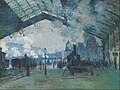 Claude Monet - Arrival of the Normandy Train, Gare Saint-Lazare
 -
 Stockton & Darlington Railway
 -
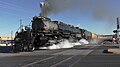 Union Pacific Big Boy 4014 Departing Las Vegas, NV, October 8th, 2019
 -
 Djursholmsbanan 1890s


.jpg)
.jpg)
.jpg)
.jpg)


.jpg)


