Gemstone: Difference between revisions
CSV import |
CSV import |
||
| Line 32: | Line 32: | ||
[[Category:Minerals]] | [[Category:Minerals]] | ||
[[Category:Jewelry]] | [[Category:Jewelry]] | ||
<gallery> | |||
File:Cardinal_gems.png|Cardinal gems | |||
File:Gem.pebbles.800pix.labelled.jpg|Gem pebbles | |||
File:Spanish_jewellery-Gold_and_emerald_pendant_at_VAM-01.jpg|Spanish jewellery Gold and emerald pendant | |||
File:Pendant_(cropped).jpg|Pendant | |||
File:Diamond_cutter._Amsterdam._2012.jpg|Diamond cutter Amsterdam 2012 | |||
File:Aurora_Pyramid_of_Hope.jpg|Aurora Pyramid of Hope | |||
File:Semiprecious_stones_in_a_piece_of_jewellery.jpeg|Semiprecious stones in a piece of jewellery | |||
File:Emerald_Fracture_Filled_Rainbow.jpg|Emerald Fracture Filled Rainbow | |||
File:Pearl_from_Pinctada_maxima_(gold-lipped_pearl_oyster)_1.jpg|Pearl from Pinctada maxima (gold-lipped pearl oyster) | |||
File:Verneuil_process_diagram.svg|Verneuil process diagram | |||
File:Golden_Apatite.jpg|Golden Apatite | |||
File:Auguste_Victor_Louis_Verneuil.jpg|Auguste Victor Louis Verneuil | |||
</gallery> | |||
Latest revision as of 21:02, 23 February 2025
Gemstone is a piece of mineral crystal which, in cut and polished form, is used to make jewelry or other adornments. However, certain rocks (such as lapis lazuli and opal) and occasionally organic materials that are not minerals (such as amber, jet, and pearl) are also used for jewelry and are therefore often considered to be gemstones as well. Most gemstones are hard, but some soft minerals are used in jewelry because of their luster or other physical properties that have aesthetic value. Rarity is another characteristic that lends value to a gemstone.
Formation and characteristics[edit]
Gemstones are formed from geologic processes such as mineralization and are typically found in igneous rock, sedimentary rock, and metamorphic rock. They are classified based on their crystal structure, chemical composition, and optical properties. Some gemstones, such as diamonds, are formed deep within the Earth's crust under conditions of intense heat and pressure, while others, such as amethyst, form in the Earth's surface layers.
Types of gemstones[edit]
There are many different types of gemstones, each with its own unique properties. Some of the most well-known gemstones include:
- Diamond: The hardest known natural material, diamonds are prized for their brilliance and durability.
- Ruby: Known for their deep red color, rubies are one of the four precious gemstones.
- Sapphire: Typically blue, sapphires can also come in a variety of other colors.
- Emerald: These green gemstones are highly prized and are one of the four precious gemstones.
- Amethyst: A type of quartz known for its purple color.
- Opal: Known for their play of color, opals can display a wide range of colors within a single stone.
Gemstone grading[edit]
Gemstones are graded based on the Four Cs: color, clarity, cut, and carat weight. The grading process is complex and requires specialized knowledge and equipment. The Gemological Institute of America (GIA) is one of the most well-known and respected organizations that grade and certify gemstones.
See also[edit]
 | |
|---|---|
 |
 |
-
 Cardinal gems
 -
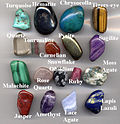 Gem pebbles
 -
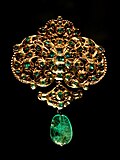 Spanish jewellery Gold and emerald pendant
 -
 Pendant
 -
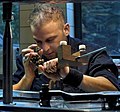 Diamond cutter Amsterdam 2012
 -
 Aurora Pyramid of Hope
 -
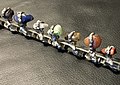 Semiprecious stones in a piece of jewellery
 -
 Emerald Fracture Filled Rainbow
 -
 Pearl from Pinctada maxima (gold-lipped pearl oyster)
 -
 Verneuil process diagram
 -
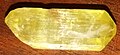 Golden Apatite
 -
 Auguste Victor Louis Verneuil


.jpg)


_1.jpg)


