Epithelioid sarcoma: Difference between revisions
CSV import |
CSV import |
||
| (One intermediate revision by the same user not shown) | |||
| Line 1: | Line 1: | ||
{{SI}} | |||
{{Infobox medical condition | |||
| name = Epithelioid sarcoma | |||
| image = [[File:Epithelioid_sarcoma_-_cropped_-_very_high_mag.jpg|alt=Micrograph of epithelioid sarcoma]] | |||
| image_size = 250px | |||
| alt = Micrograph of epithelioid sarcoma | |||
| caption = Micrograph of epithelioid sarcoma | |||
| field = [[Oncology]] | |||
| symptoms = [[Nodule]], [[ulceration]], [[pain]] | |||
| complications = [[Metastasis]] | |||
| onset = Typically in young adults | |||
| duration = Chronic | |||
| types = Distal, proximal | |||
| causes = Unknown | |||
| risks = [[Male]] gender, [[young adult]] | |||
| diagnosis = [[Biopsy]], [[immunohistochemistry]] | |||
| differential = [[Synovial sarcoma]], [[granuloma]], [[epidermoid cyst]] | |||
| prevention = None known | |||
| treatment = [[Surgery]], [[radiation therapy]], [[chemotherapy]] | |||
| medication = [[Doxorubicin]], [[ifosfamide]] | |||
| prognosis = Variable, depends on stage and location | |||
| frequency = Rare | |||
}} | |||
'''Epithelioid sarcoma''' is a rare type of [[sarcoma]] that typically arises in the soft tissue of the extremities, often in the hands or feet. It is characterized by the presence of epithelioid cells, which resemble the epithelial cells that line the body's cavities and surfaces. | '''Epithelioid sarcoma''' is a rare type of [[sarcoma]] that typically arises in the soft tissue of the extremities, often in the hands or feet. It is characterized by the presence of epithelioid cells, which resemble the epithelial cells that line the body's cavities and surfaces. | ||
== Symptoms == | == Symptoms == | ||
The most common symptom of epithelioid sarcoma is a slow-growing lump or swelling. This may be accompanied by pain or discomfort. In some cases, the disease may cause skin ulcers or other changes in the skin. | The most common symptom of epithelioid sarcoma is a slow-growing lump or swelling. This may be accompanied by pain or discomfort. In some cases, the disease may cause skin ulcers or other changes in the skin. | ||
== Causes == | == Causes == | ||
The exact cause of epithelioid sarcoma is unknown. However, it is thought to arise from changes in the DNA of cells, which cause them to grow and divide uncontrollably. | The exact cause of epithelioid sarcoma is unknown. However, it is thought to arise from changes in the DNA of cells, which cause them to grow and divide uncontrollably. | ||
== Diagnosis == | == Diagnosis == | ||
Diagnosis of epithelioid sarcoma typically involves a combination of physical examination, imaging tests such as [[MRI]] or [[CT scan]], and biopsy. The biopsy sample is examined under a microscope to look for the characteristic epithelioid cells. | Diagnosis of epithelioid sarcoma typically involves a combination of physical examination, imaging tests such as [[MRI]] or [[CT scan]], and biopsy. The biopsy sample is examined under a microscope to look for the characteristic epithelioid cells. | ||
== Treatment == | == Treatment == | ||
Treatment for epithelioid sarcoma usually involves surgery to remove the tumor. This may be followed by [[radiation therapy]] or [[chemotherapy]] to kill any remaining cancer cells. In some cases, targeted therapies or immunotherapies may be used. | Treatment for epithelioid sarcoma usually involves surgery to remove the tumor. This may be followed by [[radiation therapy]] or [[chemotherapy]] to kill any remaining cancer cells. In some cases, targeted therapies or immunotherapies may be used. | ||
== Prognosis == | == Prognosis == | ||
The prognosis for epithelioid sarcoma varies depending on the size and location of the tumor, the patient's overall health, and the extent to which the disease has spread at the time of diagnosis. | The prognosis for epithelioid sarcoma varies depending on the size and location of the tumor, the patient's overall health, and the extent to which the disease has spread at the time of diagnosis. | ||
==Images== | |||
<gallery> | |||
File:Epithelioid_sarcoma_-_intermed_mag.jpg|Epithelioid sarcoma at intermediate magnification | |||
File:Epithelioid_sarcoma_-_high_mag.jpg|Epithelioid sarcoma at high magnification | |||
File:Epithelioid_sarcoma_-_smarcb1_-_high_mag.jpg|Epithelioid sarcoma with SMARCB1 staining at high magnification | |||
</gallery> | |||
== See also == | == See also == | ||
* [[Sarcoma]] | * [[Sarcoma]] | ||
| Line 21: | Line 44: | ||
* [[Chemotherapy]] | * [[Chemotherapy]] | ||
* [[Radiation therapy]] | * [[Radiation therapy]] | ||
[[Category:Cancer]] | [[Category:Cancer]] | ||
[[Category:Sarcoma]] | [[Category:Sarcoma]] | ||
[[Category:Rare diseases]] | [[Category:Rare diseases]] | ||
{{stub}} | {{stub}} | ||
Latest revision as of 15:07, 6 April 2025

Editor-In-Chief: Prab R Tumpati, MD
Obesity, Sleep & Internal medicine
Founder, WikiMD Wellnesspedia &
W8MD medical weight loss NYC and sleep center NYC
| Epithelioid sarcoma | |
|---|---|

| |
| Synonyms | N/A |
| Pronounce | N/A |
| Specialty | N/A |
| Symptoms | Nodule, ulceration, pain |
| Complications | Metastasis |
| Onset | Typically in young adults |
| Duration | Chronic |
| Types | Distal, proximal |
| Causes | Unknown |
| Risks | Male gender, young adult |
| Diagnosis | Biopsy, immunohistochemistry |
| Differential diagnosis | Synovial sarcoma, granuloma, epidermoid cyst |
| Prevention | None known |
| Treatment | Surgery, radiation therapy, chemotherapy |
| Medication | Doxorubicin, ifosfamide |
| Prognosis | Variable, depends on stage and location |
| Frequency | Rare |
| Deaths | N/A |
Epithelioid sarcoma is a rare type of sarcoma that typically arises in the soft tissue of the extremities, often in the hands or feet. It is characterized by the presence of epithelioid cells, which resemble the epithelial cells that line the body's cavities and surfaces.
Symptoms[edit]
The most common symptom of epithelioid sarcoma is a slow-growing lump or swelling. This may be accompanied by pain or discomfort. In some cases, the disease may cause skin ulcers or other changes in the skin.
Causes[edit]
The exact cause of epithelioid sarcoma is unknown. However, it is thought to arise from changes in the DNA of cells, which cause them to grow and divide uncontrollably.
Diagnosis[edit]
Diagnosis of epithelioid sarcoma typically involves a combination of physical examination, imaging tests such as MRI or CT scan, and biopsy. The biopsy sample is examined under a microscope to look for the characteristic epithelioid cells.
Treatment[edit]
Treatment for epithelioid sarcoma usually involves surgery to remove the tumor. This may be followed by radiation therapy or chemotherapy to kill any remaining cancer cells. In some cases, targeted therapies or immunotherapies may be used.
Prognosis[edit]
The prognosis for epithelioid sarcoma varies depending on the size and location of the tumor, the patient's overall health, and the extent to which the disease has spread at the time of diagnosis.
Images[edit]
-
 Epithelioid sarcoma at intermediate magnification
 -
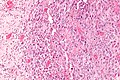 Epithelioid sarcoma at high magnification
 -
 Epithelioid sarcoma with SMARCB1 staining at high magnification


