Myrica rubra: Difference between revisions
CSV import Tags: mobile edit mobile web edit |
CSV import |
||
| Line 37: | Line 37: | ||
* [http://www.iucnredlist.org/details/62030997/0 IUCN Red List] | * [http://www.iucnredlist.org/details/62030997/0 IUCN Red List] | ||
{{dictionary-stub1}} | {{dictionary-stub1}} | ||
<gallery> | |||
File:Berkeley_Yangmei_Tree.jpg|Berkeley Yangmei Tree | |||
File:Ripe_yangmei.jpg|Ripe yangmei | |||
File:The_American_garden_(1891)_(18149564851).jpg|The American garden (1891) | |||
File:Purple_pearl_yangmei_in_Fremont,_California.jpg|Purple pearl yangmei in Fremont, California | |||
</gallery> | |||
Latest revision as of 21:38, 20 February 2025
Myrica rubra[edit]
Myrica rubra, also known as the Bayberry, Red Bayberry, or Chinese Bayberry, is a subtropical tree species native to eastern Asia, specifically China and Japan. It is a member of the Myricaceae family and is known for its bright red, edible fruit.
Description[edit]
The Myrica rubra tree can grow up to 10-20 meters tall. The bark is gray and smooth, while the leaves are alternate, simple, and 3-8 cm long. The flowers are small and green, with male and female flowers on separate trees. The fruit, which is a small drupe, is bright red, sweet, and sour in taste.
Cultivation[edit]
Myrica rubra is widely cultivated in China for its fruit. The tree prefers a subtropical climate and well-drained soil. It is typically propagated through seeds, cuttings, or grafting. The fruit is harvested in the summer months.
Uses[edit]
The fruit of the Myrica rubra tree is consumed fresh and is also used in the production of wine, juice, and jam. The bark and leaves have medicinal properties and are used in traditional Chinese medicine.
Conservation Status[edit]
While the Myrica rubra tree is not currently listed as threatened or endangered, habitat loss due to urbanization and agriculture is a concern for this species.
See Also[edit]
References[edit]
- Flora of China – Myricaceae
- The Plant List – Myrica rubra
- IUCN Red List – Myrica rubra
External Links[edit]

-
 Berkeley Yangmei Tree
 -
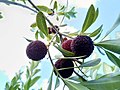 Ripe yangmei
 -
 The American garden (1891)
 -
 Purple pearl yangmei in Fremont, California


_(18149564851).jpg)

