Lizard: Difference between revisions
CSV import Tags: mobile edit mobile web edit |
CSV import |
||
| Line 27: | Line 27: | ||
{{stub}} | {{stub}} | ||
== Lizard == | |||
<gallery> | |||
File:Lizard_Collage.jpg|Lizard Collage | |||
File:Mediterranean_house_gecko1.jpg|Mediterranean house gecko | |||
File:Red_Tegu_Skull.jpg|Red Tegu Skull | |||
File:Gecko_foot_on_glass.JPG|Gecko foot on glass | |||
File:Nile_Monitor_(Varanus_niloticus)_(16545024096).jpg|Nile Monitor (Varanus niloticus) | |||
File:Bearded_Dragon_Skeleton.jpg|Bearded Dragon Skeleton | |||
File:AZ_Gila_Monster_02.jpg|Gila Monster | |||
File:Trachylepis_maculilabris_mating.jpg|Trachylepis maculilabris mating | |||
File:EasternFenceLizard_Egg.png|Eastern Fence Lizard Egg | |||
File:Fighting_Sand_lizards_(Lacerta_agilis)_4295304.jpg|Fighting Sand lizards (Lacerta agilis) | |||
File:Green_anole.jpg|Green anole | |||
File:Lizard_namely_Oriental_Garden_Lizard.jpg|Oriental Garden Lizard | |||
</gallery> | |||
Latest revision as of 21:24, 23 February 2025
Lizards are a widespread group of squamate reptiles, with sizes ranging from tiny geckos and anoles to the large Komodo dragon. Most lizards are quadrupedal, running with a strong side-to-side motion. Others are legless, and have long snake-like bodies. Some such as the forest-dwelling Draco lizards are able to glide. They are often territorial, the males fighting off other males and signalling, often with brightly colours, to attract mates and to intimidate rivals. Lizards are mainly carnivorous, often being sit-and-wait predators; many smaller species eat insects, while the Komodo eats mammals as big as water buffalo.
Taxonomy and classification[edit]
Lizards are classified as part of the Squamata order of reptiles, which also includes snakes. They are further divided into multiple families, such as the Agamidae (dragon lizards), Gekkonidae (geckos), and Varanidae (monitor lizards), among others.
Anatomy and physiology[edit]
Lizards typically have feet and external ears, while many lizards can detach their tails to escape from predators. They have a high metabolic rate from among the reptiles. Many lizards also have well-developed visual depth perception and keen eyesight, making them skilled hunters.
Behavior[edit]
Lizards employ a variety of behavioral adaptations, including territorial behavior, parasitic behavior, and in some species, a form of social organization. Many species are also known for their ability to "play dead" or "freeze" in the presence of a threat.
Reproduction[edit]
Most lizards lay eggs, with some species being ovoviviparous (giving birth to live young). Many lizards also exhibit various forms of parental care, with females guarding their nests and young.
Conservation[edit]
Many species of lizards are threatened by habitat loss, pollution, and introduced species. Conservation efforts are being made worldwide to protect endangered lizard species.
See also[edit]
References[edit]
<references />
 | |
|---|---|
 |
 |
Lizard[edit]
-
 Lizard Collage
 -
 Mediterranean house gecko
 -
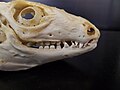 Red Tegu Skull
 -
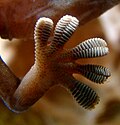 Gecko foot on glass
 -
 Nile Monitor (Varanus niloticus)
 -
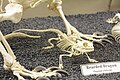 Bearded Dragon Skeleton
 -
 Gila Monster
 -
 Trachylepis maculilabris mating
 -
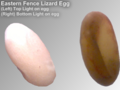 Eastern Fence Lizard Egg
 -
 Fighting Sand lizards (Lacerta agilis)
 -
 Green anole
 -
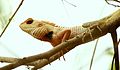 Oriental Garden Lizard


_(16545024096).jpg)


_4295304.jpg)


