Dura mater: Difference between revisions
CSV import Tags: mobile edit mobile web edit |
CSV import |
||
| Line 25: | Line 25: | ||
[[Category:Neuroanatomy]] | [[Category:Neuroanatomy]] | ||
[[Category:Neurology]] | [[Category:Neurology]] | ||
<gallery> | |||
File:Meninges-en.svg|Diagram of the meninges, including the dura mater | |||
File:Sobo_1909_589.png|Illustration from Sobo 1909 showing the dura mater | |||
File:Gray767.png|Gray's Anatomy illustration of the dura mater | |||
File:Gray488_blue.gif|Gray's Anatomy illustration of the cranial dura mater | |||
File:Blausen_0327_Dura.png|Medical illustration of the dura mater | |||
File:Gray769.png|Gray's Anatomy illustration of the spinal dura mater | |||
File:Gray770-en.svg|Diagram of the cranial dura mater | |||
File:Slide1drdr.GIF|Histological slide showing the dura mater | |||
File:Slide3dsdd.GIF|Histological slide showing the dura mater | |||
File:Streptococcus_pneumoniae_meningitis,_gross_pathology_33_lores.jpg|Gross pathology of meningitis affecting the dura mater | |||
</gallery> | |||
Latest revision as of 11:29, 18 February 2025
Dura mater is a thick membrane that is the outermost of the three layers of the meninges that surround the brain and spinal cord. The other two meningeal layers are the pia mater and the arachnoid mater. The dura mater is responsible for keeping in the cerebrospinal fluid.
Structure[edit]
The dura mater is a thick, durable membrane, closest to the skull and vertebrae. The name "dura mater" derives from the Latin for "tough mother" (as a translation from Arabic) to denote its protective role. It is composed of two layers, the endosteal layer (closest to the skull), and the meningeal layer. The layers are normally fused, except in specific areas where they separate to form dural sinuses.
Function[edit]
The primary function of the dura mater is to protect the brain and spinal cord. It provides a supportive, protective enclosure for the brain and spinal cord and works in conjunction with the other meningeal layers, the cerebrospinal fluid, and the skull and vertebral column to safeguard the delicate tissues of the central nervous system.
Clinical significance[edit]
Inflammation of the dura mater, a condition known as dural inflammation, can result in severe headaches and other neurological symptoms. This can be caused by infection, direct injury, or as a result of surgery.
See also[edit]
References[edit]
<references />
 | |
|---|---|
 |
 |
-
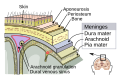 Diagram of the meninges, including the dura mater
 -
 Illustration from Sobo 1909 showing the dura mater
 -
 Gray's Anatomy illustration of the dura mater
 -
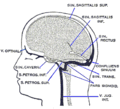 Gray's Anatomy illustration of the cranial dura mater
 -
 Medical illustration of the dura mater
 -
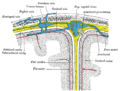 Gray's Anatomy illustration of the spinal dura mater
 -
 Diagram of the cranial dura mater
 -
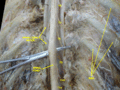 Histological slide showing the dura mater
 -
 Histological slide showing the dura mater
 -
 Gross pathology of meningitis affecting the dura mater


