Gram-positive bacteria: Difference between revisions
CSV import |
CSV import |
||
| Line 42: | Line 42: | ||
{{stub}} | {{stub}} | ||
<gallery> | |||
File:Gram_Stain_Anthrax.jpg|Gram stain of Bacillus anthracis | |||
File:Gram_stain_01.jpg|Gram stain showing Gram-positive bacteria | |||
File:Gram-Cell-wall.svg|Diagram of Gram-positive cell wall | |||
File:Gram-positive_cellwall-schematic.png|Schematic of Gram-positive cell wall | |||
File:Gram_Positive_Classification.svg|Classification of Gram-positive bacteria | |||
File:Mureine.svg|Structure of murein in Gram-positive bacteria | |||
File:Actinomyces_spp_01.jpg|Actinomyces species under microscope | |||
</gallery> | |||
Latest revision as of 11:12, 18 February 2025
Gram-positive bacteria are a type of bacteria that are classified by the color they turn after a chemical called Gram stain is applied to them. Gram-positive bacteria turn blue when this stain is applied, while Gram-negative bacteria do not.
Characteristics[edit]
Gram-positive bacteria have a thick cell wall that is rich in peptidoglycan. This cell wall is responsible for the bacteria's ability to retain the Gram stain. In addition to the cell wall, some Gram-positive bacteria have a layer of polysaccharide or teichoic acid on their surface.
Types of Gram-positive bacteria[edit]
There are many types of Gram-positive bacteria, including:
Diseases caused by Gram-positive bacteria[edit]
Gram-positive bacteria can cause a variety of diseases, including:
- Staphylococcus aureus can cause skin infections, pneumonia, and food poisoning.
- Streptococcus pneumoniae can cause pneumonia, meningitis, and otitis media.
- Enterococcus faecalis and Enterococcus faecium can cause urinary tract infections, bacteremia, and endocarditis.
- Listeria monocytogenes can cause listeriosis, a serious infection usually caused by eating food contaminated with the bacteria.
- Bacillus anthracis causes anthrax, a rare but serious illness.
- Clostridium difficile causes infections that can range from diarrhea to life-threatening inflammation of the colon.
Treatment[edit]
Gram-positive bacteria are usually sensitive to penicillin and other beta-lactam antibiotics. However, some Gram-positive bacteria have developed resistance to these antibiotics, making treatment more difficult.
See also[edit]
 | |
|---|---|
 |
 |
-
 Gram stain of Bacillus anthracis
 -
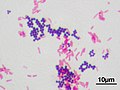 Gram stain showing Gram-positive bacteria
 -
 Diagram of Gram-positive cell wall
 -
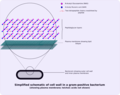 Schematic of Gram-positive cell wall
 -
Classification of Gram-positive bacteria
-
Structure of murein in Gram-positive bacteria
-
Actinomyces species under microscope


