Charge-transfer complex: Difference between revisions
CSV import |
CSV import |
||
| Line 44: | Line 44: | ||
== References == | == References == | ||
{{dictionary-stub1}} | {{dictionary-stub1}} | ||
<gallery> | |||
File:PYRTNB03.png|Charge-transfer complex | |||
File:SegStackEdgeOnHMTFCQ.jpg|Charge-transfer complex | |||
File:SegStackEndOnHMTFCQ.jpg|Charge-transfer complex | |||
</gallery> | |||
Latest revision as of 02:11, 18 February 2025
Charge-transfer complex[edit]
A charge-transfer complex (CT complex) refers to a type of chemical complex formed between two or more molecules or ions, where there is a transfer of electronic charge from one species to another. This phenomenon occurs due to the difference in electronegativity between the participating species, resulting in the formation of a new entity with distinct properties.
Formation[edit]
The formation of a charge-transfer complex involves the interaction between a donor molecule or ion and an acceptor molecule or ion. The donor species typically possesses a higher electron density, while the acceptor species has a lower electron density. This difference in electron density creates an electrostatic attraction between the two species, leading to the formation of the complex.
Properties[edit]
Charge-transfer complexes exhibit unique properties that distinguish them from the individual donor and acceptor species. Some of the notable properties include:
1. Absorption Spectra: CT complexes often display characteristic absorption spectra due to the electronic transitions associated with the charge transfer process. These spectra can be used to identify and characterize the complex.
2. Coloration: Many charge-transfer complexes exhibit intense colors, which can be attributed to the electronic transitions mentioned above. The color of the complex can vary depending on the nature of the donor and acceptor species involved.
3. Stability: The stability of a charge-transfer complex depends on various factors such as the strength of the donor-acceptor interaction, the solvent environment, and the temperature. In some cases, the complex may dissociate upon changes in these conditions.
Applications[edit]
Charge-transfer complexes find applications in various fields, including:
1. Sensing: The unique optical properties of CT complexes make them useful in sensing applications. They can be employed as indicators for the presence of specific analytes or as probes for monitoring chemical reactions.
2. Photovoltaics: CT complexes have been investigated for their potential use in organic solar cells. The efficient charge transfer between the donor and acceptor species can enhance the overall performance of the device.
3. Molecular Electronics: The ability of charge-transfer complexes to transport charge across molecules has led to their exploration in the field of molecular electronics. They can be utilized as building blocks for constructing functional electronic devices at the molecular level.
Examples[edit]
Several well-known charge-transfer complexes include:
1. Ferrocene-Tetracyanoethylene (Fc-TCNE): This complex exhibits a deep blue color and has been extensively studied due to its interesting electronic properties.
2. Perylene-Tetracyanoquinodimethane (PTC): PTC complexes are known for their strong absorption in the visible region, making them suitable for applications in organic electronics.
3. Pyrene-Tetracyanoethylene (Py-TCNE): This complex is widely used as a model system for studying charge-transfer processes and has been employed in various research studies.
See also[edit]
References[edit]

-
 Charge-transfer complex
 -
 Charge-transfer complex
 -
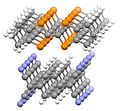 Charge-transfer complex


