Buccopharyngeal membrane: Difference between revisions
CSV import |
CSV import |
||
| (3 intermediate revisions by the same user not shown) | |||
| Line 1: | Line 1: | ||
''' | The '''buccopharyngeal membrane''' is a critical structure in the early development of the human embryo. It is a thin membrane that separates the [[stomodeum]] (primitive mouth) from the [[pharynx]] in the developing embryo. This membrane is composed of ectoderm and endoderm, without any intervening mesoderm. | ||
== | === Development === | ||
The | The buccopharyngeal membrane forms during the third week of embryonic development. It is located at the cranial end of the embryo, marking the boundary between the future mouth and the pharynx. The membrane is derived from the [[ectoderm]] and [[endoderm]], two of the three primary germ layers in the embryo. | ||
During the fourth week of development, the buccopharyngeal membrane ruptures, creating an open connection between the mouth and the pharynx. This rupture is a crucial step in the formation of the [[oral cavity]] and the [[digestive tract]]. | |||
==Function== | === Function === | ||
The primary function of the buccopharyngeal membrane is to separate the | The primary function of the buccopharyngeal membrane is to temporarily separate the stomodeum from the pharynx. This separation is essential for the proper development of the facial structures and the oral cavity. Once the membrane ruptures, it allows for the continuity of the digestive tract, enabling the embryo to begin swallowing amniotic fluid, which is important for the development of the [[gastrointestinal tract]]. | ||
== | === Clinical Significance === | ||
Abnormalities in the development or rupture of the buccopharyngeal membrane can lead to congenital anomalies. For example, if the membrane fails to rupture, it can result in a condition known as [[choanal atresia]], where the nasal passages are blocked, affecting breathing and feeding in the newborn. | |||
== | == Related Pages == | ||
* [[ | * [[Embryology]] | ||
* [[ | * [[Germ layer]] | ||
* [[ | * [[Stomodeum]] | ||
* [[Pharynx]] | |||
* [[Oral cavity]] | |||
[[Category:Embryology]] | [[Category:Embryology]] | ||
<gallery> | |||
File:Gray977.png|Gray's Anatomy illustration of the buccopharyngeal membrane | |||
</gallery> | |||
Latest revision as of 23:58, 24 February 2025
The buccopharyngeal membrane is a critical structure in the early development of the human embryo. It is a thin membrane that separates the stomodeum (primitive mouth) from the pharynx in the developing embryo. This membrane is composed of ectoderm and endoderm, without any intervening mesoderm.
Development[edit]
The buccopharyngeal membrane forms during the third week of embryonic development. It is located at the cranial end of the embryo, marking the boundary between the future mouth and the pharynx. The membrane is derived from the ectoderm and endoderm, two of the three primary germ layers in the embryo.
During the fourth week of development, the buccopharyngeal membrane ruptures, creating an open connection between the mouth and the pharynx. This rupture is a crucial step in the formation of the oral cavity and the digestive tract.
Function[edit]
The primary function of the buccopharyngeal membrane is to temporarily separate the stomodeum from the pharynx. This separation is essential for the proper development of the facial structures and the oral cavity. Once the membrane ruptures, it allows for the continuity of the digestive tract, enabling the embryo to begin swallowing amniotic fluid, which is important for the development of the gastrointestinal tract.
Clinical Significance[edit]
Abnormalities in the development or rupture of the buccopharyngeal membrane can lead to congenital anomalies. For example, if the membrane fails to rupture, it can result in a condition known as choanal atresia, where the nasal passages are blocked, affecting breathing and feeding in the newborn.
Related Pages[edit]
-
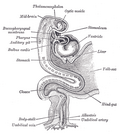 Gray's Anatomy illustration of the buccopharyngeal membrane

