Flower of Kent: Difference between revisions
CSV import |
CSV import |
||
| (One intermediate revision by the same user not shown) | |||
| Line 27: | Line 27: | ||
[[Category:Apple cultivars]] | [[Category:Apple cultivars]] | ||
[[Category:English apples]] | [[Category:English apples]] | ||
<gallery> | |||
File:Newton's_tree,_Botanic_Gardens,_Cambridge.JPG | |||
</gallery> | |||
<gallery> | |||
File:Newton's_tree,_Botanic_Gardens,_Cambridge.JPG|Newton's tree, Botanic Gardens, Cambridge | |||
</gallery> | |||
Latest revision as of 11:54, 25 February 2025
Flower of Kent[edit]
Flower of Kent
{{This apple cultivar related article is a stub.}}
Flower of Kent is a cultivar of apple (Malus domestica) that originated in England. It is a popular variety known for its unique characteristics and historical significance.
History[edit]
The Flower of Kent apple has a rich history dating back to the 16th century. It is believed to be the variety that Sir Isaac Newton observed falling from a tree, leading to his discovery of the law of gravity. This event is famously known as the "apple falling on Newton's head."
Characteristics[edit]
The Flower of Kent apple is medium to large in size, with a round shape and a slightly irregular appearance. It has a greenish-yellow skin that is often flushed with red on the side exposed to the sun. The flesh is crisp, juicy, and slightly tart, making it suitable for both eating fresh and cooking.
Cultivation[edit]
Flower of Kent apple trees are vigorous and have a spreading growth habit. They are known to be hardy and can tolerate a wide range of climates. The trees require full sun and well-drained soil to thrive. They are typically harvested in late summer or early fall.
Uses[edit]
Due to its firm texture and tart flavor, the Flower of Kent apple is commonly used in cooking and baking. It is particularly well-suited for making pies, tarts, and applesauce. The apple's unique flavor profile also makes it a popular choice for cider production.
References[edit]
<references group="" responsive="1"></references>

-
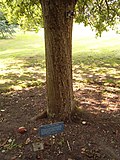 Newton's tree, Botanic Gardens, Cambridge
