March Against Monsanto: Difference between revisions
CSV import |
CSV import |
||
| Line 40: | Line 40: | ||
[[Category:Protests]] | [[Category:Protests]] | ||
[[Category:Genetically Modified Organisms]] | [[Category:Genetically Modified Organisms]] | ||
<gallery> | |||
File:March_Against_Monsanto_Vancouver.jpg|March Against Monsanto in Vancouver | |||
File:Tami_Canal_cropped.jpg|Tami Canal, founder of March Against Monsanto | |||
File:2013,_Stockholm_Demonstration_against_Monsanto_02.jpg|Demonstration against Monsanto in Stockholm, 2013 | |||
File:Check_the_March_Crowd_-_Probably_2-3K_Strong.jpg|Large crowd at March Against Monsanto | |||
File:2013,_Stockholm_Demonstration_against_Monsanto_04.jpg|Protesters in Stockholm, 2013 | |||
File:March_Against_Monsanto,_Eugene_32.jpg|March Against Monsanto in Eugene | |||
File:Contre_Monsanto,_mai_2015,_Toulouse-1978.jpg|Protest against Monsanto in Toulouse, 2015 | |||
File:March_Against_Monsanto_(Old_San_Juan,_Puerto_Rico).jpg|March Against Monsanto in Old San Juan, Puerto Rico | |||
</gallery> | |||
Latest revision as of 12:24, 18 February 2025
March Against Monsanto[edit]
The March Against Monsanto is an annual protest event that takes place in various cities around the world. It is organized by activists and concerned individuals who oppose the practices of the multinational agrochemical and agricultural biotechnology corporation, Monsanto.
Background[edit]
Monsanto is a controversial company known for its production of genetically modified organisms (GMOs) and the herbicide glyphosate, commonly known as Roundup. Critics argue that Monsanto's GMOs pose potential risks to human health and the environment, while supporters claim that these technologies are necessary for increasing food production and addressing global hunger.
History[edit]
The first March Against Monsanto took place on May 25, 2013. It was organized as a response to the global March Against Monsanto call to action, which aimed to raise awareness about the company's practices and advocate for transparency in the food industry. The event gained significant media attention and attracted participants from various backgrounds, including environmentalists, farmers, and concerned consumers.
Since its inception, the March Against Monsanto has grown into a global movement, with protests occurring in numerous countries each year. Participants use the event as an opportunity to voice their concerns about Monsanto's influence on the food system and to advocate for sustainable and organic alternatives.
Goals and Objectives[edit]
The primary goal of the March Against Monsanto is to raise awareness about the potential risks associated with GMOs and Monsanto's agricultural practices. Participants aim to educate the public about the importance of food sovereignty, the right of individuals and communities to control their own food systems.
Additionally, the movement seeks to promote sustainable and organic farming practices as alternatives to industrial agriculture. Advocates argue that these methods are more environmentally friendly, support biodiversity, and prioritize the health and well-being of consumers.
Impact and Controversies[edit]
The March Against Monsanto has had a significant impact on public discourse surrounding GMOs and Monsanto's practices. It has helped to bring attention to the issue and has contributed to the growing demand for transparency in the food industry.
However, the movement has also faced criticism and controversy. Some argue that the protests oversimplify complex scientific issues and fail to acknowledge the potential benefits of GMOs. Others claim that the movement is driven by misinformation and fear-mongering.
See Also[edit]
References[edit]
<references />
-
 March Against Monsanto in Vancouver
 -
 Tami Canal, founder of March Against Monsanto
 -
 Demonstration against Monsanto in Stockholm, 2013
 -
 Large crowd at March Against Monsanto
 -
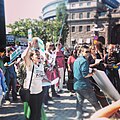 Protesters in Stockholm, 2013
 -
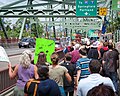 March Against Monsanto in Eugene
 -
 Protest against Monsanto in Toulouse, 2015
 -
 March Against Monsanto in Old San Juan, Puerto Rico


.jpg)
