Mala Mogodu: Difference between revisions
CSV import |
CSV import Tags: mobile edit mobile web edit |
||
| (One intermediate revision by the same user not shown) | |||
| Line 25: | Line 25: | ||
[[Category:Zulu culture]] | [[Category:Zulu culture]] | ||
[[Category:Xhosa culture]] | [[Category:Xhosa culture]] | ||
<gallery> | |||
File:Mala_Mogodu01.jpg | |||
File:Mala_Mogodu02.jpg | |||
</gallery> | |||
<gallery> | |||
File:Mala_Mogodu01.jpg|Mala Mogodu 01 | |||
File:Mala_Mogodu02.jpg|Mala Mogodu 02 | |||
</gallery> | |||
Latest revision as of 11:22, 25 February 2025
Mala Mogodu is a traditional South African dish that is popular among the Zulu and Xhosa communities. It is a delicacy made from the tripe and intestines of a cow or sheep. In this article, we will explore the history, ingredients, preparation, and cultural significance of Mala Mogodu.
History[edit]
The origins of Mala Mogodu can be traced back to the indigenous tribes of South Africa. The dish has been a part of their culinary traditions for centuries. It is believed that Mala Mogodu was initially created as a way to utilize all parts of the animal and minimize waste. Over time, it has become a beloved dish that is enjoyed by many.
Ingredients[edit]
The main ingredients used in Mala Mogodu include tripe and intestines from a cow or sheep. These are thoroughly cleaned and prepared before cooking. Other ingredients commonly used in the dish include onions, garlic, tomatoes, and various spices such as paprika, cumin, and coriander. The dish is typically cooked in a rich and flavorful broth.
Preparation[edit]
To prepare Mala Mogodu, the tripe and intestines are first cleaned and boiled to remove any impurities. They are then cut into smaller pieces and cooked in a pot with onions, garlic, and tomatoes. The spices are added to enhance the flavor of the dish. The mixture is simmered for several hours until the tripe and intestines are tender and the flavors have melded together. Mala Mogodu is traditionally served with pap, a type of maize porridge, or with steamed bread.
Cultural Significance[edit]
Mala Mogodu holds significant cultural importance in South Africa. It is often served during special occasions and celebrations, such as weddings and family gatherings. The dish is considered a symbol of unity and togetherness, as it is often shared among family and friends. Mala Mogodu is also a way to honor and preserve the culinary traditions of the indigenous tribes of South Africa.
See Also[edit]
References[edit]


-
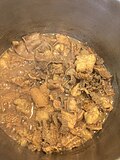 Mala Mogodu 01
 -
 Mala Mogodu 02
