Dredge oyster: Difference between revisions
CSV import Tags: mobile edit mobile web edit |
CSV import |
||
| Line 31: | Line 31: | ||
[[Category:Fishing equipment]] | [[Category:Fishing equipment]] | ||
[[Category:Oysters]] | [[Category:Oysters]] | ||
<gallery> | |||
File:Naturalis_Biodiversity_Center_-_ZMA.MOLL.415097_-_Ostrea_chilensis_Philippi,_1846_-_Ostreidae_-_Mollusc_shell.jpeg|Ostrea chilensis shell | |||
File:Bluff_oysters_on_ice.jpg|Bluff oysters on ice | |||
File:New_Zealand_bluff_oysters.jpg|New Zealand bluff oysters | |||
</gallery> | |||
Latest revision as of 04:17, 18 February 2025
Dredge Oyster[edit]
The dredge oyster, also known as the oyster dredge, is a tool used in the harvesting of oysters. It is a specialized device designed to efficiently collect oysters from the seabed or oyster beds. In this article, we will explore the construction, usage, and impact of the dredge oyster.
Construction[edit]
The dredge oyster consists of a metal frame with a mesh bag attached to it. The frame is typically made of steel or iron, and it is shaped like a rectangular or circular basket. The mesh bag is made of a durable material, such as nylon or wire, and it is designed to allow water to pass through while retaining the oysters.
Usage[edit]
To use the dredge oyster, it is attached to a boat or a barge using ropes or chains. The boat then drags the dredge along the seabed or oyster beds, allowing the mesh bag to collect oysters as it moves. The dredge is typically dragged for a specific distance or time, depending on the regulations and the desired oyster yield.
Once the dredge is lifted out of the water, the collected oysters are emptied into containers for further processing. The oysters can be sorted, cleaned, and prepared for sale or consumption. The dredge oyster allows for efficient harvesting of oysters, as it can collect a large quantity in a single pass.
Impact[edit]
The use of dredge oysters has both positive and negative impacts on the environment and the oyster population. On the positive side, dredging can help remove excess sediment and debris from oyster beds, improving water quality and creating a healthier habitat for oysters and other marine organisms.
However, dredging can also have negative effects. The dragging of the dredge along the seabed can disrupt the natural structure of the habitat, damaging or destroying other marine life and their habitats. It can also result in the unintentional capture of non-target species, leading to bycatch and potential ecological imbalance.
See Also[edit]
References[edit]
<references />
-
 Ostrea chilensis shell
 -
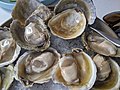 Bluff oysters on ice
 -
 New Zealand bluff oysters


