Factorial experiment: Difference between revisions
CSV import |
No edit summary |
||
| (2 intermediate revisions by the same user not shown) | |||
| Line 38: | Line 38: | ||
[[Category:Statistics]] | [[Category:Statistics]] | ||
[[Category:Research Techniques]] | [[Category:Research Techniques]] | ||
== Factorial_experiment == | |||
<gallery> | |||
File:Response_surface_metodology.jpg|Response surface methodology | |||
File:Cube_plot_for_bearing_life.svg|Cube plot for bearing life | |||
File:Factorial_Design.svg|Factorial Design | |||
File:Montgomery_filtration_rates.svg|Montgomery filtration rates | |||
File:Interaction_plots_filtration_rate.png|Interaction plots filtration rate | |||
File:Pareto_plot_filtration_rate.svg|Pareto plot filtration rate | |||
File:Montgomery_filtration_cube_plot.png|Montgomery filtration cube plot | |||
</gallery> | |||
Latest revision as of 21:02, 16 March 2025
Factorial Experiment[edit]
A factorial experiment is a type of experimental design used in statistics and research methodology. It involves studying the effects of multiple independent variables on a dependent variable, simultaneously and in combination. This design allows researchers to examine the main effects of each independent variable, as well as any interactions between them.
Design[edit]
In a factorial experiment, the independent variables are manipulated at different levels or conditions. These levels can be either categorical or continuous. For example, if we are studying the effects of two independent variables, A and B, each with two levels, we would have a 2x2 factorial design. This means that there are four different conditions or treatment combinations: A1B1, A1B2, A2B1, and A2B2.
Main Effects[edit]
The main effects in a factorial experiment refer to the individual effects of each independent variable on the dependent variable. By analyzing the main effects, researchers can determine the impact of each independent variable on the outcome. For example, if we find that variable A has a significant main effect, it means that changing the levels of A leads to a significant change in the dependent variable, regardless of the levels of variable B.
Interactions[edit]
Interactions occur when the effects of one independent variable depend on the levels of another independent variable. In a factorial experiment, interactions can be additive or multiplicative. An additive interaction means that the combined effect of the two variables is equal to the sum of their individual effects. On the other hand, a multiplicative interaction means that the combined effect is greater or smaller than the sum of the individual effects.
Advantages[edit]
Factorial experiments offer several advantages over other experimental designs. Firstly, they allow researchers to study multiple independent variables simultaneously, which can provide a more comprehensive understanding of the research question. Secondly, factorial designs are efficient in terms of sample size, as they require fewer participants compared to conducting separate experiments for each independent variable. Lastly, factorial experiments enable the examination of interactions between variables, which can reveal complex relationships that may not be apparent in single-variable studies.
Applications[edit]
Factorial experiments are widely used in various fields, including psychology, biology, marketing, and engineering. They can be applied to study the effects of different factors on consumer behavior, the efficacy of medical treatments, the impact of environmental factors on plant growth, and much more. By systematically manipulating and analyzing multiple variables, factorial experiments provide valuable insights into the relationships between variables and their effects on the dependent variable.
See Also[edit]
References[edit]
<references />
Factorial_experiment[edit]
-
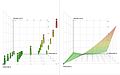 Response surface methodology
 -
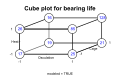 Cube plot for bearing life
 -
 Factorial Design
 -
 Montgomery filtration rates
 -
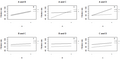 Interaction plots filtration rate
 -
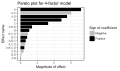 Pareto plot filtration rate
 -
 Montgomery filtration cube plot


