Praxinoscope: Difference between revisions
CSV import |
CSV import |
||
| Line 34: | Line 34: | ||
[[Category:Animation devices]] | [[Category:Animation devices]] | ||
[[Category:19th-century inventions]] | [[Category:19th-century inventions]] | ||
<gallery> | |||
File:Lanature1879_praxinoscope_reynaud.png|Praxinoscope by Reynaud, 1879 | |||
File:Lanature1882_praxinoscope_projection_reynaud.png|Praxinoscope Projection by Reynaud, 1882 | |||
File:Theatreoptique.jpg|Théâtre Optique | |||
File:Thinktank_Birmingham_-_object_1961S01481.00001(1).jpg|Praxinoscope | |||
</gallery> | |||
Latest revision as of 05:05, 18 February 2025
Praxinoscope[edit]
The Praxinoscope is an early animation device that was invented in the late 19th century. It is considered to be one of the precursors to modern animation techniques. The device consists of a cylindrical drum with a series of images or drawings placed on the inner surface. When the drum is spun, the images appear to move, creating the illusion of animation.
History[edit]
The Praxinoscope was invented by French scientist Charles-Émile Reynaud in 1877. Reynaud was inspired by the earlier Zoetrope, another animation device that used a similar principle of spinning images to create the illusion of motion. However, the Praxinoscope improved upon the Zoetrope by using a system of mirrors that reflected the images, resulting in a clearer and more stable animation.
Operation[edit]
The Praxinoscope consists of a drum with a series of evenly spaced vertical slits on the outer surface. Inside the drum, a strip of images or drawings is placed on the inner surface. The strip is looped around the drum, with each image aligned with a corresponding slit on the outer surface. When the drum is spun, a viewer looks through the slits and sees a rapid succession of images, creating the illusion of movement.
Significance[edit]
The Praxinoscope was a significant development in the history of animation. It allowed for the creation of more complex and detailed animations than previous devices, such as the Zoetrope. The use of mirrors in the Praxinoscope also improved the quality of the animation, making it more realistic and lifelike.
Legacy[edit]
Although the Praxinoscope was eventually overshadowed by more advanced animation techniques, its influence can still be seen in modern animation. The basic principle of creating the illusion of movement through a series of rapidly changing images is still used today. The Praxinoscope also paved the way for the development of other animation devices, such as the flip book and the modern-day film projector.
See Also[edit]
References[edit]
<references />
-
 Praxinoscope by Reynaud, 1879
 -
 Praxinoscope Projection by Reynaud, 1882
 -
 Théâtre Optique
 -
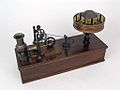 Praxinoscope


.jpg)
