Rhodanese: Difference between revisions
CSV import |
CSV import |
||
| Line 27: | Line 27: | ||
[[Category:Biochemistry]] | [[Category:Biochemistry]] | ||
[[Category:Genetic Disorders]] | [[Category:Genetic Disorders]] | ||
<gallery> | |||
File:Rhodanase.png|Rhodanase | |||
File:Rhodanase2.png|Rhodanase2 | |||
</gallery> | |||
Latest revision as of 00:30, 27 February 2025
Rhodanese is an enzyme that plays a crucial role in the detoxification process of cyanide in living organisms. It is found in various tissues, including the liver, kidneys, and intestines. Rhodanese catalyzes the conversion of cyanide into thiocyanate, a less toxic compound that can be easily excreted from the body.
Function[edit]
Rhodanese is primarily responsible for the detoxification of cyanide, a highly toxic compound that can be found in various sources, such as certain plants, industrial chemicals, and even cigarette smoke. Cyanide inhibits the proper functioning of cytochrome c oxidase, an enzyme involved in cellular respiration. By converting cyanide into thiocyanate, rhodanese prevents the accumulation of cyanide in the body and protects against its harmful effects.
Mechanism of Action[edit]
The mechanism by which rhodanese converts cyanide into thiocyanate involves the transfer of a sulfur atom from a sulfur donor molecule, such as thiosulfate, to cyanide. This sulfur transfer reaction results in the formation of thiocyanate and the regeneration of the sulfur donor molecule. Rhodanese acts as a catalyst in this reaction, facilitating the transfer of the sulfur atom without being consumed in the process.
Importance in Detoxification[edit]
The detoxification of cyanide by rhodanese is crucial for the survival of organisms exposed to cyanide-containing substances. Cyanide poisoning can lead to severe health complications, including respiratory failure, cardiovascular collapse, and even death. Rhodanese helps prevent these adverse effects by rapidly converting cyanide into thiocyanate, which can be safely eliminated from the body through urine.
Clinical Significance[edit]
Rhodanese deficiency in humans is a rare genetic disorder that can lead to an increased susceptibility to cyanide poisoning. Individuals with this condition may experience symptoms such as headache, dizziness, nausea, and confusion after exposure to cyanide. Diagnosis of rhodanese deficiency is typically confirmed through genetic testing. Treatment options for cyanide poisoning in individuals with rhodanese deficiency may include the administration of specific antidotes, such as hydroxocobalamin or sodium thiosulfate.
References[edit]
1. Rhodanese - Wikipedia 2. Rhodanese deficiency - PubMed
See Also[edit]
-
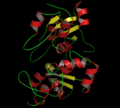 Rhodanase
 -
 Rhodanase2


