Prunus africana: Difference between revisions
CSV import |
CSV import |
||
| Line 31: | Line 31: | ||
[[Category:Medicinal plants]] | [[Category:Medicinal plants]] | ||
[[Category:Conservation]] | [[Category:Conservation]] | ||
== Prunus africana == | |||
<gallery> | |||
File:Prunus_africana_MS_3588.jpg|Prunus africana | |||
File:Prunus_africana_nectaries.jpg|Prunus africana nectaries | |||
File:Prunus_sappling.jpg|Prunus sapling | |||
</gallery> | |||
Latest revision as of 01:33, 18 February 2025
Prunus africana[edit]
Prunus africana, commonly known as the African cherry or the African plum, is a species of tree native to the African continent. It belongs to the Rosaceae family and is widely distributed across several countries in Africa, including Cameroon, Kenya, Tanzania, and Uganda.
Description[edit]
Prunus africana is a medium-sized evergreen tree that can reach heights of up to 40 meters. It has a straight trunk with a dense, rounded crown. The bark is smooth and grayish-brown when young, but becomes rough and dark brown as the tree matures. The leaves are elliptical in shape, dark green in color, and have serrated edges. The tree produces small, fragrant white flowers in clusters, which are followed by small, oval-shaped fruits that turn from green to black when ripe.
Uses[edit]
Prunus africana has been traditionally used by indigenous African communities for various purposes. The bark of the tree is particularly valued for its medicinal properties. It contains active compounds such as phytosterols and pentacyclic triterpenes, which have been found to have anti-inflammatory and anti-cancer properties. Extracts from the bark are commonly used in traditional medicine to treat various ailments, including prostate problems, urinary tract infections, and stomach disorders.
In addition to its medicinal uses, Prunus africana also has commercial value. The timber from the tree is highly sought after for its durability and resistance to decay. It is commonly used in the construction of furniture, flooring, and other wooden products. The tree also provides a valuable source of income for local communities through the sustainable harvesting of its bark and timber.
Conservation[edit]
Prunus africana is currently facing threats due to overexploitation and habitat loss. The high demand for its bark and timber has led to unsustainable harvesting practices, which have resulted in a decline in its population in certain areas. In response to these threats, several conservation initiatives have been implemented to protect and manage the species. These include the establishment of protected areas, the promotion of sustainable harvesting practices, and the cultivation of Prunus africana in plantations.
References[edit]
1.
Prunus africana(link). {{{website}}}. IUCN Red List of Threatened Species.
2. ,
 Pharmacological effects of Prunus africana on the prostate,
 Pharmaceutical Biology,
 2016,
 Vol. 54(Issue: 7),
 pp. 1159-1166,
 DOI: 10.3109/13880209.2015.1075939,
See also[edit]
Prunus africana[edit]
-
 Prunus africana
 -
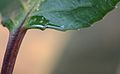 Prunus africana nectaries
 -
 Prunus sapling


