Fast atom bombardment: Difference between revisions
CSV import |
CSV import |
||
| Line 32: | Line 32: | ||
[[Category:Analytical chemistry]] | [[Category:Analytical chemistry]] | ||
[[Category:Ionization techniques]] | [[Category:Ionization techniques]] | ||
<gallery> | |||
File:FAB_Schematic.jpg|Schematic of Fast Atom Bombardment | |||
File:Fast_atom_bombardment_diagram.png|Diagram of Fast Atom Bombardment | |||
File:FAB_MS.jpg|Mass Spectrometry using Fast Atom Bombardment | |||
</gallery> | |||
Latest revision as of 02:06, 18 February 2025
Fast atom bombardment (FAB) is a technique used in mass spectrometry to ionize and analyze large molecules. It was first introduced in the 1980s as an alternative to other ionization methods such as electron impact and chemical ionization. FAB has since become a widely used technique in the field of analytical chemistry.
History[edit]
The development of FAB can be traced back to the work of Michael Barber and his colleagues at the University of Manchester in the late 1970s. They were investigating ways to ionize large biomolecules, such as proteins and peptides, for mass spectrometry analysis. Traditional ionization methods were not suitable for these molecules due to their size and complexity.
Barber and his team realized that bombarding the sample with a beam of high-energy atoms could effectively ionize the molecules. They experimented with different types of atoms, including xenon and argon, and found that xenon atoms produced the best results. This led to the development of the FAB technique.
Technique[edit]
In FAB, a sample is mixed with a liquid matrix, typically glycerol or thioglycerol, to form a thin film on a metal target. The target is then bombarded with a beam of high-energy atoms, usually xenon or argon, which causes the molecules in the sample to be ionized. The ions are then extracted from the matrix and introduced into the mass spectrometer for analysis.
The use of a liquid matrix is crucial in FAB as it helps to desorb and ionize the molecules. The matrix absorbs the energy from the bombarding atoms and transfers it to the sample, resulting in the ionization of the molecules. The choice of matrix depends on the nature of the sample and the desired ionization efficiency.
Applications[edit]
FAB has found numerous applications in various fields of research. It has been widely used in the analysis of biomolecules, such as proteins, peptides, and nucleic acids. FAB allows for the determination of molecular weights and structural information of these molecules, which is essential for understanding their biological functions.
FAB has also been used in the analysis of synthetic polymers, natural products, and small organic molecules. It has proven to be a valuable tool in the identification and characterization of these compounds. Additionally, FAB has been employed in the analysis of drugs and pharmaceuticals, providing valuable information on their structure and purity.
Advantages and Limitations[edit]
One of the main advantages of FAB is its ability to ionize large molecules without extensive fragmentation. This allows for the analysis of intact molecular ions, providing valuable information on their mass and structure. FAB is also a relatively simple and fast technique, making it suitable for routine analysis in many laboratories.
However, FAB does have some limitations. It is primarily suited for polar and moderately polar compounds, and may not be effective for nonpolar or highly polar molecules. The use of a liquid matrix can also introduce background ions, which may interfere with the analysis. Additionally, FAB requires a dedicated ion source and specialized equipment, which may limit its accessibility in some laboratories.
See also[edit]
References[edit]
<references />
-
 Schematic of Fast Atom Bombardment
 -
 Diagram of Fast Atom Bombardment
 -
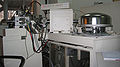 Mass Spectrometry using Fast Atom Bombardment


