External ballistics: Difference between revisions
CSV import |
CSV import |
||
| Line 50: | Line 50: | ||
[[Category:Military technology]] | [[Category:Military technology]] | ||
[[Category:Projectile weapons]] | [[Category:Projectile weapons]] | ||
<gallery> | |||
File:Bullet_Wiki.ogv|External ballistics | |||
File:M855_drop_during_25-meter_zeroing_trajectory_M16A2_M4.jpg|M855 drop during 25-meter zeroing trajectory | |||
File:Photography_of_bow_shock_waves_around_a_brass_bullet,_1888.jpg|Photography of bow shock waves around a brass bullet, 1888 | |||
File:G1_Shape_Standard_Projectile_Measurements_in_Calibers.png|G1 Shape Standard Projectile Measurements in Calibers | |||
File:G7_Shape_Standard_Projectile_Measurements_in_Calibers.png|G7 Shape Standard Projectile Measurements in Calibers | |||
File:Five301906govtBullets.png|Five .30-1906 government bullets | |||
File:7.9_SS_and_SME_Patrone.jpg|7.9 SS and SME Patrone | |||
File:Sketch_of_Magnus_effect_with_streamlines_and_turbulent_wake.svg|Sketch of Magnus effect with streamlines and turbulent wake | |||
</gallery> | |||
Latest revision as of 12:01, 18 February 2025
External Ballistics
External ballistics is a branch of ballistics that focuses on the behavior of projectiles in flight. It involves the study of various factors that affect the trajectory, stability, and impact of projectiles, such as bullets, artillery shells, rockets, and missiles. Understanding external ballistics is crucial for accurate long-range shooting, artillery fire, and the design of effective ballistic missiles.
Factors Affecting External Ballistics[edit]
Several factors influence the external ballistics of projectiles. These factors include:
Velocity[edit]
The initial velocity of a projectile plays a significant role in determining its trajectory and range. Higher velocities generally result in flatter trajectories and longer ranges. The velocity can be affected by factors such as the propellant charge, barrel length, and aerodynamic characteristics of the projectile.
Drag[edit]
Drag is the resistance encountered by a projectile as it moves through the air. It is influenced by the shape, size, and surface roughness of the projectile. Drag increases with velocity and affects the trajectory by causing the projectile to slow down and deviate from its intended path.
Gravity[edit]
Gravity is a constant force that acts on projectiles, causing them to follow a curved trajectory. The effect of gravity becomes more pronounced over longer distances. Understanding the gravitational pull is crucial for accurate long-range shooting and artillery fire.
Wind[edit]
Wind is a significant external factor that affects the trajectory of projectiles. It can cause the projectile to drift off course, leading to a miss or reduced accuracy. Wind speed, direction, and gusts need to be considered when calculating the trajectory and making adjustments for accurate shooting.
Spin[edit]
Spin stabilization is commonly used to improve the stability and accuracy of projectiles. The spin imparts gyroscopic stability, allowing the projectile to resist destabilizing forces such as yaw and pitch. The spin rate and direction are critical factors in determining the stability and accuracy of a projectile.
Applications of External Ballistics[edit]
External ballistics has numerous practical applications in various fields, including:
Long-Range Shooting[edit]
Understanding external ballistics is essential for long-range shooting, where factors such as bullet drop, wind drift, and atmospheric conditions significantly affect accuracy. By considering these factors, shooters can make the necessary adjustments to hit targets accurately at extended distances.
Artillery Fire[edit]
Artillery units rely on external ballistics to accurately engage targets at long distances. Factors such as projectile weight, muzzle velocity, elevation, and atmospheric conditions are taken into account to calculate the trajectory and make adjustments for accurate fire.
Ballistic Missiles[edit]
External ballistics plays a crucial role in the design and operation of ballistic missiles. Engineers consider factors such as launch angle, velocity, atmospheric conditions, and target distance to ensure the missile reaches its intended target accurately.
See Also[edit]
References[edit]
<references />
-
 External ballistics
 -
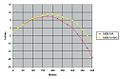 M855 drop during 25-meter zeroing trajectory
 -
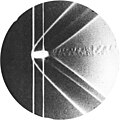 Photography of bow shock waves around a brass bullet, 1888
 -
 G1 Shape Standard Projectile Measurements in Calibers
 -
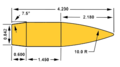 G7 Shape Standard Projectile Measurements in Calibers
 -
 Five .30-1906 government bullets
 -
 7.9 SS and SME Patrone
 -
 Sketch of Magnus effect with streamlines and turbulent wake


