Excitatory postsynaptic potential: Difference between revisions
CSV import |
CSV import |
||
| Line 35: | Line 35: | ||
[[Category:Synaptic Transmission]] | [[Category:Synaptic Transmission]] | ||
[[Category:Neuronal Communication]] | [[Category:Neuronal Communication]] | ||
== Excitatory postsynaptic potential == | |||
<gallery> | |||
File:Synapse_diag6.png|Synapse diagram 6 | |||
File:Synapse_diag5.png|Synapse diagram 5 | |||
</gallery> | |||
Latest revision as of 00:38, 27 February 2025
Excitatory Postsynaptic Potential[edit]
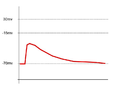
The excitatory postsynaptic potential (EPSP) is a phenomenon that occurs in the nervous system, specifically at the synapses between neurons. It is a transient change in the membrane potential of a postsynaptic neuron, which is caused by the release of neurotransmitters from a presynaptic neuron. The EPSP is an important mechanism for transmitting and integrating signals in the brain.
Mechanism[edit]
The EPSP is initiated when an action potential reaches the presynaptic terminal of a neuron. This triggers the release of neurotransmitters, such as glutamate, into the synaptic cleft. The neurotransmitters then bind to specific receptors on the postsynaptic neuron, which are typically ligand-gated ion channels.
When the neurotransmitters bind to the receptors, the ion channels open, allowing the influx of positively charged ions, such as sodium (Na+) or calcium (Ca2+), into the postsynaptic neuron. This influx of positive ions depolarizes the membrane potential of the postsynaptic neuron, making it more likely to generate an action potential.
Effects[edit]
The EPSP has several effects on the postsynaptic neuron. Firstly, it increases the excitability of the neuron, making it more likely to fire an action potential. This is due to the depolarization of the membrane potential, which brings the neuron closer to its threshold for firing an action potential.
Secondly, the EPSP can also lead to the summation of multiple EPSPs. If multiple presynaptic neurons release neurotransmitters onto the same postsynaptic neuron at the same time or in quick succession, the EPSPs can add up and reach the threshold for generating an action potential. This phenomenon is known as temporal or spatial summation.
Significance[edit]
The EPSP plays a crucial role in the communication between neurons and the integration of signals in the brain. It is a fundamental mechanism for transmitting information from one neuron to another. By depolarizing the postsynaptic neuron, the EPSP allows for the propagation of signals and the coordination of neuronal activity.
Furthermore, the EPSP is involved in various physiological processes, such as learning and memory. The strength and duration of the EPSP can be modulated by various factors, including the number of presynaptic inputs, the release of neurotransmitters, and the properties of the postsynaptic receptors. This modulation allows for the fine-tuning of synaptic transmission and the plasticity of neuronal connections.
See Also[edit]
References[edit]
<references />
Excitatory postsynaptic potential[edit]
-
 Synapse diagram 6
 -
 Synapse diagram 5


