Magenta: Difference between revisions
CSV import |
CSV import |
||
| (One intermediate revision by the same user not shown) | |||
| Line 1: | Line 1: | ||
'''Magenta''' is a color that is | ==Magenta== | ||
[[File:MagentaIcon.png|Magenta icon|thumb|right]] | |||
'''Magenta''' is a color that is made by combining equal parts of red and blue light. It is a secondary color in the [[RGB color model]], which is used to create colors on digital screens. Magenta is also a primary color in the [[CMYK color model]], which is used in color printing. | |||
==History== | |||
The color magenta was first introduced in 1859, following the Battle of Magenta, a battle fought in the Italian War of Independence. The dye was originally called "fuchsine" but was later renamed "magenta" to commemorate the battle. The synthetic dye was one of the first aniline dyes, derived from coal tar. | |||
==Color Theory== | |||
[[File:RGB_color_wheel.svg|RGB color wheel showing magenta|thumb|left]] | |||
In the [[RGB color model]], magenta is created by mixing red and blue light at full intensity. It is located midway between red and blue on the RGB color wheel. In the [[CMYK color model]], magenta is one of the four primary colors used in color printing, along with cyan, yellow, and black. | |||
Magenta is complementary to green; when combined, these colors cancel each other out, producing a grayscale color. This is because magenta and green are opposite each other on the color wheel. | |||
==Perception== | |||
[[File:Cone-fundamentals-with-srgb-spectrum.svg|Cone fundamentals with sRGB spectrum|thumb|right]] | |||
Magenta is not found in the visible spectrum of light. It is a non-spectral color, meaning it cannot be generated by a single wavelength of light. Instead, it is perceived by the human eye when red and blue light are combined. The perception of magenta is a result of the way our eyes and brain process light. | |||
== | ==Applications== | ||
Magenta is widely used in art and design due to its vibrant and eye-catching nature. It is often used to create a sense of energy and excitement. In printing, magenta is a crucial component of the CMYK color model, allowing for the reproduction of a wide range of colors. | |||
==Cultural Significance== | |||
Magenta has various cultural associations. It is often associated with creativity, innovation, and non-conformity. In some cultures, magenta is seen as a color of harmony and balance. | |||
== | ==Related Pages== | ||
* [[Color theory]] | |||
* [[RGB color model]] | * [[RGB color model]] | ||
* [[CMYK color model]] | * [[CMYK color model]] | ||
* [[ | * [[Visible spectrum]] | ||
[[File:Blue_and_red_make_magenta.png|Blue and red make magenta|thumb|left]] | |||
==Gallery== | |||
<gallery> | <gallery> | ||
File:Linear_visible_spectrum.svg|Linear visible spectrum showing magenta | |||
File:Linear_visible_spectrum.svg| | File:SubtractiveColor.svg|Subtractive color model with magenta | ||
File:Blended_colour_wheel.svg|Blended color wheel with magenta | |||
File:DoubleFuchsias_wb.jpg|Double fuchsias showing natural magenta | |||
File:SubtractiveColor.svg| | |||
File:Blended_colour_wheel.svg| | |||
File:DoubleFuchsias_wb.jpg| | |||
</gallery> | </gallery> | ||
[[Category:Colors]] | |||
Latest revision as of 11:06, 23 March 2025
Magenta[edit]

Magenta is a color that is made by combining equal parts of red and blue light. It is a secondary color in the RGB color model, which is used to create colors on digital screens. Magenta is also a primary color in the CMYK color model, which is used in color printing.
History[edit]
The color magenta was first introduced in 1859, following the Battle of Magenta, a battle fought in the Italian War of Independence. The dye was originally called "fuchsine" but was later renamed "magenta" to commemorate the battle. The synthetic dye was one of the first aniline dyes, derived from coal tar.
Color Theory[edit]

In the RGB color model, magenta is created by mixing red and blue light at full intensity. It is located midway between red and blue on the RGB color wheel. In the CMYK color model, magenta is one of the four primary colors used in color printing, along with cyan, yellow, and black.
Magenta is complementary to green; when combined, these colors cancel each other out, producing a grayscale color. This is because magenta and green are opposite each other on the color wheel.
Perception[edit]

Magenta is not found in the visible spectrum of light. It is a non-spectral color, meaning it cannot be generated by a single wavelength of light. Instead, it is perceived by the human eye when red and blue light are combined. The perception of magenta is a result of the way our eyes and brain process light.
Applications[edit]
Magenta is widely used in art and design due to its vibrant and eye-catching nature. It is often used to create a sense of energy and excitement. In printing, magenta is a crucial component of the CMYK color model, allowing for the reproduction of a wide range of colors.
Cultural Significance[edit]
Magenta has various cultural associations. It is often associated with creativity, innovation, and non-conformity. In some cultures, magenta is seen as a color of harmony and balance.
Related Pages[edit]

Gallery[edit]
-
 Linear visible spectrum showing magenta
 -
 Subtractive color model with magenta
 -
 Blended color wheel with magenta
 -
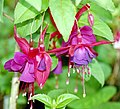 Double fuchsias showing natural magenta


