Nectriaceae: Difference between revisions
CSV import |
No edit summary |
||
| Line 26: | Line 26: | ||
[[Category:Hypocreales]] | [[Category:Hypocreales]] | ||
{{Fungi-stub}} | {{Fungi-stub}} | ||
== Nectriaceae gallery == | == Nectriaceae gallery == | ||
<gallery> | <gallery> | ||
File:Nectria cinnabarina.jpg|Nectria cinnabarina | File:Nectria cinnabarina.jpg|Nectria cinnabarina | ||
</gallery> | </gallery> | ||
Latest revision as of 00:46, 17 March 2025
Nectriaceae is a family of fungi that belongs to the order Hypocreales. This family is known for its diverse range of species, many of which are significant in both ecological and economic contexts.
Taxonomy[edit]
The family Nectriaceae was first described by the German mycologist Heinrich Friedrich Link in 1809. It is classified under the class Sordariomycetes, order Hypocreales, and phylum Ascomycota. The family includes several genera, such as Nectria, Fusarium, and Cylindrocarpon among others.
Characteristics[edit]
Members of the Nectriaceae family are typically characterized by their brightly colored perithecia, which are flask-shaped structures that produce ascospores. These fungi are also known for their ability to produce mycotoxins, which can be harmful to both humans and animals.
Ecology and Distribution[edit]
Nectriaceae fungi are found worldwide, with a distribution that spans across various climates and ecosystems. They are particularly prevalent in temperate and tropical regions. These fungi play a crucial role in the decomposition of organic matter, contributing to nutrient cycling in ecosystems.
Economic and Health Impact[edit]
Several species within the Nectriaceae family are of economic importance due to their role as plant pathogens. For instance, species of the genus Fusarium are known to cause Fusarium wilt in a variety of crops, leading to significant agricultural losses. Additionally, some Nectriaceae fungi produce mycotoxins that can contaminate food and feed, posing a risk to human and animal health.
Research and Studies[edit]
Research into Nectriaceae fungi has provided valuable insights into fungal biology, plant pathology, and mycotoxin production. These studies have implications for agriculture, food safety, and the development of antifungal treatments.

Nectriaceae gallery[edit]
-
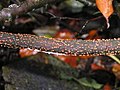 Nectria cinnabarina

