Myocardial perfusion imaging: Difference between revisions
CSV import |
No edit summary |
||
| (2 intermediate revisions by the same user not shown) | |||
| Line 32: | Line 32: | ||
[[Category:Nuclear medicine]] | [[Category:Nuclear medicine]] | ||
{{medicine-stub}} | {{medicine-stub}} | ||
<gallery> | |||
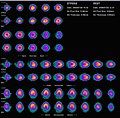
File:Nl mpi2.jpg|Myocardial perfusion imaging | |||
</gallery> | |||
Latest revision as of 00:46, 17 March 2025
Myocardial Perfusion Imaging (MPI) is a non-invasive imaging test that illustrates how well blood flows through (perfuses) your heart muscle. It can show areas of the heart muscle that aren't getting enough blood flow. This test is often called a nuclear stress test. It can also show the size of the heart chambers, how well they're functioning, and whether there's any damage to them.
Overview[edit]
Myocardial perfusion imaging (MPI) is a form of imaging test that uses a small amount of radioactive substance to detect the health of heart muscle cells and the blood flow to them. This test can be used to diagnose coronary artery disease and other heart conditions.
Procedure[edit]
During the MPI test, a small amount of radioactive substance is injected into the patient's bloodstream. This substance, called a radiotracer, travels through the blood to the heart. A special camera, called a gamma camera, is then used to take pictures of the heart. These pictures can show areas of the heart that may not be receiving enough blood.
Uses[edit]
MPI is used to diagnose and monitor certain heart conditions, such as coronary artery disease, heart attacks, and heart failure. It can also be used to determine how well treatment for these conditions is working.
Risks[edit]
As with any medical procedure, there are some risks associated with MPI. These include allergic reactions to the radiotracer, damage to the veins from the injection, and exposure to radiation. However, the amount of radiation a patient is exposed to during MPI is usually very small.
See also[edit]
References[edit]
<references group="" responsive="1"></references>

-
 Myocardial perfusion imaging

