Ligamentum venosum: Difference between revisions
CSV import Tags: mobile edit mobile web edit |
No edit summary |
||
| Line 27: | Line 27: | ||
[[Category:Liver]] | [[Category:Liver]] | ||
{{anatomy-stub}} | {{anatomy-stub}} | ||
== Ligamentum venosum gallery == | == Ligamentum venosum gallery == | ||
<gallery> | <gallery> | ||
Latest revision as of 00:39, 17 March 2025
Ligamentum venosum is a fibrous remnant of the ductus venosus, a blood vessel found in the fetal circulation. It is located in the liver and is part of the anatomy of the human body.
Anatomy[edit]
The ligamentum venosum is a small ligament that is situated in the left lobe of the liver. It is a remnant of the ductus venosus of the fetal circulation, which shunts a portion of the left umbilical vein blood flow directly to the inferior vena cava. Thus, it allows oxygenated blood from the placenta to bypass the liver. In the fetus, the ductus venosus closes functionally within a few minutes of birth, and structurally within a few days of birth, at which point it becomes the ligamentum venosum.
Function[edit]
In the fetus, the ductus venosus plays a crucial role in delivering oxygenated blood from the placenta to the heart, bypassing the liver. After birth, the ductus venosus closes and becomes the ligamentum venosum. The ligamentum venosum does not have a known function in the adult human body.
Clinical significance[edit]
The ligamentum venosum is not typically visible in imaging studies of the liver, but it can be seen in certain conditions. For example, it may be visible in cases of portal hypertension, a condition characterized by increased blood pressure within the portal venous system, which can occur as a result of liver disease.
See also[edit]
References[edit]
<references group="" responsive="1"></references>

Ligamentum venosum gallery[edit]
-
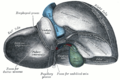 Gray1087-liver
 -
 Gray502


