Fan death: Difference between revisions
CSV import |
No edit summary |
||
| (One intermediate revision by the same user not shown) | |||
| Line 19: | Line 19: | ||
[[Category:Urban legends]] | [[Category:Urban legends]] | ||
{{myth-stub}} | {{myth-stub}} | ||
<gallery> | |||
File:Korean_fans_closeup.jpg|Korean fans closeup | |||
</gallery> | |||
Latest revision as of 21:03, 16 March 2025
Fan death is a widely held belief in South Korea that running an electric fan in a closed room with unopened or no windows will prove fatal. Despite no concrete evidence to support this theory, it has become a significant part of South Korean culture and safety concerns, leading to the implementation of timer functions on fans to prevent them from running overnight or for extended periods.
Origins and Beliefs[edit]
The origins of fan death are unclear, but the belief has been present in South Korean culture since at least the 1970s. It is thought to stem from a combination of media reports, misinterpretation of cause of death, and the South Korean government's efforts to reduce energy consumption during that time period. The theory suggests that using an electric fan in a closed space can lead to asphyxiation, hypothermia, or carbon dioxide poisoning, although none of these claims have been scientifically proven.
Scientific Viewpoint[edit]
From a scientific perspective, the belief in fan death is considered a myth. Experts argue that while a fan can circulate air and potentially lower oxygen levels if used in an extremely confined space, the effect is not significant enough to cause death. Similarly, the theory that fans can cause hypothermia is also debunked by the fact that the cooling effect of a fan on a human body does not significantly reduce body temperature to dangerous levels.
Cultural Impact[edit]
Despite the lack of scientific evidence, the belief in fan death persists in South Korea. This has led manufacturers to include timers and other safety features on electric fans sold in the country. The media also plays a role in perpetuating the myth, with occasional reports of deaths where a running fan in a closed room is highlighted as a possible cause.
Preventive Measures[edit]
In response to the widespread belief in fan death, South Korean fan manufacturers have implemented various safety features. These include automatic shut-off timers, motion sensors, and even low power settings. Such measures are designed to alleviate fears and reduce the perceived risk of fan death among the public.
Conclusion[edit]
Fan death remains a unique example of how cultural beliefs can influence consumer behavior and product design, despite a lack of scientific backing. It highlights the power of myth and media in shaping perceptions and practices around everyday objects.

-
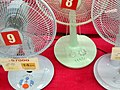 Korean fans closeup

