Republic of Ireland: Difference between revisions
CSV import |
|||
| Line 50: | Line 50: | ||
File:The Long Fellow (10570624475).jpg|The Long Fellow | File:The Long Fellow (10570624475).jpg|The Long Fellow | ||
File:IFS Constitution Committee Darrell F's book2.jpg|IFS Constitution Committee | File:IFS Constitution Committee Darrell F's book2.jpg|IFS Constitution Committee | ||
</gallery> | </gallery> | ||
Latest revision as of 17:50, 3 March 2025
Republic of Ireland
The Republic of Ireland (Irish: Éire) is a sovereign nation located in Western Europe, occupying most of the island of Ireland. It shares a border to the north with Northern Ireland, which is part of the United Kingdom. The Republic of Ireland is known for its rich cultural heritage, lush landscapes, and vibrant cities.
Geography[edit]
The Republic of Ireland covers approximately five-sixths of the island of Ireland, with a total area of about 70,273 square kilometers. The country is characterized by its rolling green hills, rugged coastlines, and numerous lakes and rivers. The River Shannon is the longest river in Ireland, flowing southward through the central part of the country.
History[edit]
The history of the Republic of Ireland is marked by its struggle for independence from British rule. The country gained independence in 1922 following the Anglo-Irish Treaty, which ended the Irish War of Independence. The Republic of Ireland was officially declared in 1949.
Government and Politics[edit]
The Republic of Ireland is a parliamentary democracy. The President of Ireland serves as the head of state, while the Taoiseach is the head of government. The Oireachtas is the national parliament, consisting of two houses: Dáil Éireann (House of Representatives) and Seanad Éireann (Senate).
Economy[edit]
The economy of the Republic of Ireland is a modern, highly developed economy, with a focus on high-tech industries, pharmaceuticals, and financial services. The country is a member of the European Union and uses the euro as its currency.
Culture[edit]
Irish culture is renowned for its contributions to literature, music, and the arts. The country has produced many famous writers, including James Joyce, W.B. Yeats, and Samuel Beckett. Traditional Irish music and dance, such as the jig and reel, are celebrated worldwide.
Healthcare[edit]
The healthcare system in the Republic of Ireland is a mix of public and private services. The Health Service Executive (HSE) is responsible for providing public health services. Healthcare is funded through taxation, and residents are entitled to free or subsidized healthcare services.
Education[edit]
Education in the Republic of Ireland is compulsory for children from ages 6 to 16. The education system is divided into primary, secondary, and higher education. The country is home to several prestigious universities, including Trinity College Dublin and University College Dublin.
Demographics[edit]
The population of the Republic of Ireland is approximately 5 million people. The majority of the population is of Irish descent, with English and Irish (Gaelic) being the official languages. The country has a high standard of living and ranks well in terms of quality of life.
Tourism[edit]
Tourism is a significant industry in the Republic of Ireland, attracting millions of visitors each year. Popular tourist destinations include the Cliffs of Moher, the Ring of Kerry, and the historic city of Dublin.
See Also[edit]
Template:Republic of Ireland topics
Republic of Ireland gallery[edit]
-
 EU-Ireland (orthographic projection)
 -
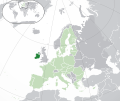 EU-Ireland
 -
 Charles Stewart Parnell at meeting
 -
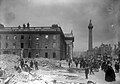 The shell of the G.P.O. on Sackville Street after the Easter Rising
 -
 Leinster House - 1911
 -
 The Long Fellow
 -
IFS Constitution Committee
.svg)


.jpg)

.jpg)

