Ecology: Difference between revisions
CSV import Tags: mobile edit mobile web edit |
CSV import |
||
| Line 34: | Line 34: | ||
[[Category:Biology]] | [[Category:Biology]] | ||
[[Category:Environmental science]] | [[Category:Environmental science]] | ||
==Ecology== | |||
<gallery> | |||
File:Bufo boreas.jpg|Bufo boreas | |||
File:Blue Linckia Starfish.JPG|Blue Linckia Starfish | |||
File:Hawk eating prey.jpg|Hawk eating prey | |||
File:European honey bee extracts nectar.jpg|European honey bee extracts nectar | |||
File:Blue Linckia Starfish.JPG|Blue Linckia Starfish | |||
File:Long-tailed Broadbill (Psarisomus dalhousiae).jpg|Long-tailed Broadbill (Psarisomus dalhousiae) | |||
File:Termite mound-Tanzania.jpg|Termite mound, Tanzania | |||
File:Male Lion and Cub Chitwa South Africa Luca Galuzzi 2004 edit1.jpg|Male Lion and Cub, Chitwa, South Africa | |||
File:Ecoecolfigure1.jpg|Ecoecolfigure1 | |||
File:Chesapeake Waterbird Food Web.jpg|Chesapeake Waterbird Food Web | |||
</gallery> | |||
Latest revision as of 06:21, 3 March 2025
Ecology is the scientific study of the interactions that determine the distribution and abundance of organisms. Predation, competition, disease, and the abiotic environment are among the interactions that ecology focuses on.
Definition[edit]
The term "ecology" was coined by the German zoologist Ernst Haeckel in 1866. He defined it as "the comprehensive science of the relationship of the organism to the environment." The variety of data types and the complexity of ecological phenomena are matched by a proliferation of ecological subdisciplines.
Subdisciplines[edit]
Ecology is a broad discipline comprising many subdisciplines. Some of these include:
- Population ecology - This branch of ecology studies the dynamics of species populations and how these populations interact with the environment.
- Community ecology - This branch of ecology involves the study of the interactions between species in communities on many spatial and temporal scales, including the distribution, structure, abundance, demography, and interactions between coexisting populations.
- Ecosystem ecology - This branch of ecology studies the flow of energy and materials through organisms and the physical environment. It involves the study of processes such as primary production, decomposition, and nutrient cycling.
- Landscape ecology - This branch of ecology involves the study of the exchanges of energy, materials, and organisms across multiple ecosystems.
- Global ecology - This branch of ecology examines the biosphere and the global distribution of species, as well as the movement of matter and energy through the biosphere.
Importance[edit]
Ecology is important for understanding the world we live in. It provides useful evidence on the interdependence between people and the natural world and, as well the consequences of human activity on the environment.
See also[edit]
References[edit]
<references />
 | |
|---|---|
 |
 |
Ecology[edit]
-
 Bufo boreas
 -
 Blue Linckia Starfish
 -
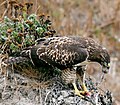 Hawk eating prey
 -
European honey bee extracts nectar
-
Blue Linckia Starfish
-
Long-tailed Broadbill (Psarisomus dalhousiae)
-
Termite mound, Tanzania
-
Male Lion and Cub, Chitwa, South Africa
-
Ecoecolfigure1
-
Chesapeake Waterbird Food Web


.jpg)


