Mountain gorilla: Difference between revisions
CSV import Tags: mobile edit mobile web edit |
CSV import |
||
| Line 34: | Line 34: | ||
[[Category:Gorillas]] | [[Category:Gorillas]] | ||
{{Primate-stub}} | {{Primate-stub}} | ||
<gallery> | |||
File:Susa group, mountain gorilla.jpg|Susa group, mountain gorilla | |||
File:Mountain gorilla (Gorilla beringei beringei) female with baby.jpg|Mountain gorilla (Gorilla beringei beringei) female with baby | |||
File:Gorilla taxonomy.jpg|Gorilla taxonomy | |||
File:Silverback of Ntambara group.JPG|Silverback of Ntambara group | |||
File:Mountain gorilla (Gorilla beringei beringei) 05.jpg|Mountain gorilla (Gorilla beringei beringei) 05 | |||
File:Mountain gorilla (Gorilla beringei beringei) female eating root.jpg|Mountain gorilla (Gorilla beringei beringei) female eating root | |||
File:Mountain gorilla (Gorilla beringei beringei) eating.jpg|Mountain gorilla (Gorilla beringei beringei) eating | |||
File:Mountain gorilla finger detail.KMRA.jpg|Mountain gorilla finger detail | |||
File:Mountain gorilla (Gorilla beringei beringei), 2-year-old.jpg|Mountain gorilla (Gorilla beringei beringei), 2-year-old | |||
File:Mountain gorilla toddler of the Nkuringo troop in the Bwindi Impenetrable National Park in Uganda.jpg|Mountain gorilla toddler of the Nkuringo troop in the Bwindi Impenetrable National Park in Uganda | |||
</gallery> | |||
Latest revision as of 06:14, 3 March 2025
Mountain Gorilla
The Mountain Gorilla (Gorilla beringei beringei) is a subspecies of the Eastern Gorilla and one of the two species of gorillas, the largest living primates. They are distinguished from other gorillas by their longer hair, larger jaws and teeth, and broader chest.
Distribution and Habitat[edit]
Mountain Gorillas are found in two separate locations: the Virunga Mountains, a range of extinct volcanoes that border the Democratic Republic of Congo, Rwanda and Uganda; and the Bwindi Impenetrable National Park in Uganda. They inhabit the high-altitude forests of these regions, typically above 2,200 meters.
Characteristics[edit]
Mountain Gorillas are highly social animals and live in stable, cohesive groups held together by long-term bonds between adult males and females. They are diurnal, most active between 6:00 a.m. and 6:00 p.m. with many rest periods throughout the day.
Diet[edit]
Mountain Gorillas are primarily herbivores; the majority of their diet consists of leaves, shoots and stems, fruits, bark and roots. They are also known to eat small invertebrates.
Conservation Status[edit]
Mountain Gorillas are listed as endangered by the International Union for Conservation of Nature (IUCN). Threats to their survival include habitat loss due to agricultural expansion, war and civil unrest, illegal hunting, disease, and capture for the illegal pet trade.
See Also[edit]
References[edit]
<references />
-
 Susa group, mountain gorilla
 -
 Mountain gorilla (Gorilla beringei beringei) female with baby
 -
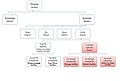 Gorilla taxonomy
 -
 Silverback of Ntambara group
 -
 Mountain gorilla (Gorilla beringei beringei) 05
 -
 Mountain gorilla (Gorilla beringei beringei) female eating root
 -
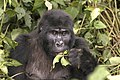 Mountain gorilla (Gorilla beringei beringei) eating
 -
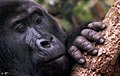 Mountain gorilla finger detail
 -
Mountain gorilla (Gorilla beringei beringei), 2-year-old
-
Mountain gorilla toddler of the Nkuringo troop in the Bwindi Impenetrable National Park in Uganda

_female_with_baby.jpg)


_05.jpg)
_female_eating_root.jpg)
_eating.jpg)


.png)
,_2-year-old.jpg)
