Reconstruction era: Difference between revisions
CSV import Tags: mobile edit mobile web edit |
CSV import |
||
| Line 31: | Line 31: | ||
{{US-history-stub}} | {{US-history-stub}} | ||
<gallery> | |||
File:ReconstructionEraColl.png|Reconstruction Era Collage | |||
File:Wealth, per capita, in the United States, from 9th US Census (1872).jpg|Wealth per capita in the United States from 9th US Census (1872) | |||
File:Broad Street Charleston South Carolina 1865.jpg|Broad Street Charleston South Carolina 1865 | |||
File:Lincoln and Johnsond.jpg|Lincoln and Johnson | |||
File:Grand Army of the Republic by Swatjester.jpg|Grand Army of the Republic | |||
File:FreedmenVotingInNewOrleans1867.jpeg|Freedmen Voting In New Orleans 1867 | |||
File:Abraham Lincoln O-77 matte collodion print.jpg|Abraham Lincoln O-77 matte collodion print | |||
File:EmancipationPhoto.jpg|Emancipation Photo | |||
File:Freedmen richmond sewing women.jpg|Freedmen Richmond Sewing Women | |||
File:Collage of Andy Johnson cartoon depictions by Thomas Nast.jpg|Collage of Andy Johnson cartoon depictions by Thomas Nast | |||
</gallery> | |||
Latest revision as of 05:54, 3 March 2025
Reconstruction era
The Reconstruction era was a pivotal period in the history of the United States, spanning from 1865 to 1877, following the end of the American Civil War. This era was marked by significant efforts to rebuild and reform the Southern United States, whose social, economic, and political systems had been devastated by the conflict. The primary goals of Reconstruction were to reintegrate the Southern states into the Union, redefine African-American rights and status, and rebuild the South's infrastructure and economy.
Background[edit]
Following the surrender of the Confederate States in 1865, the United States faced the daunting task of addressing the legacies of slavery and war. The Thirteenth Amendment to the United States Constitution, which abolished slavery, was ratified in December 1865, laying the groundwork for the Reconstruction era. However, the path to rebuilding the nation was fraught with challenges, including deep-seated racism, economic devastation, and political turmoil.
Key Legislation and Constitutional Amendments[edit]
During Reconstruction, three critical amendments to the U.S. Constitution were adopted. The Fourteenth Amendment (1868) granted citizenship to all persons born or naturalized in the United States, including former slaves, and provided equal protection under the laws. The Fifteenth Amendment (1870) prohibited the denial of the right to vote based on race, color, or previous condition of servitude.
Congress also passed several important laws, including the Reconstruction Acts, which divided the South into military districts to protect the rights of newly freed African Americans and to facilitate the Southern states' reentry into the Union.
Challenges and Opposition[edit]
The Reconstruction era faced significant opposition from various factions. The rise of white supremacist groups, such as the Ku Klux Klan, aimed to undermine Reconstruction efforts through violence and intimidation. Additionally, the implementation of "Black Codes" in the South sought to restrict the freedoms of African Americans, leading to further federal intervention.
End of Reconstruction[edit]
The end of Reconstruction is often attributed to the Compromise of 1877, which resolved the disputed 1876 presidential election between Rutherford B. Hayes and Samuel J. Tilden. As part of the compromise, Hayes was awarded the presidency in exchange for the withdrawal of federal troops from the South, effectively ending Reconstruction. This led to the imposition of "Jim Crow" laws, which enforced racial segregation and disenfranchisement of African Americans for decades to come.
Legacy[edit]
The legacy of the Reconstruction era is complex. While it failed to fully integrate African Americans into American society or eradicate racial discrimination, it laid the foundation for future civil rights movements. The amendments and laws passed during this period provided a legal framework for challenging segregation and discrimination in the 20th century.
See Also[edit]
-
 Reconstruction Era Collage
 -
 Wealth per capita in the United States from 9th US Census (1872)
 -
 Broad Street Charleston South Carolina 1865
 -
 Lincoln and Johnson
 -
 Grand Army of the Republic
 -
 Freedmen Voting In New Orleans 1867
 -
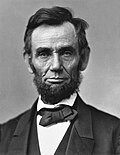 Abraham Lincoln O-77 matte collodion print
 -
 Emancipation Photo
 -
 Freedmen Richmond Sewing Women
 -
 Collage of Andy Johnson cartoon depictions by Thomas Nast

.jpg)


