Cycas: Difference between revisions
CSV import |
CSV import |
||
| Line 43: | Line 43: | ||
[[Category:Living fossils]] | [[Category:Living fossils]] | ||
[[Category:Plants described in 1753]] | [[Category:Plants described in 1753]] | ||
== Cycas gallery == | |||
<gallery> | |||
File:Big Cycas.jpg|Big Cycas | |||
File:Cycus tici.jpg|Cycus tici | |||
File:Rumphii1562.jpg|Rumphii 1562 | |||
File:Cycas male cone.jpg|Cycas male cone | |||
File:Cycas nayagarhensis Singh Radha Khuraijam.JPG|Cycas nayagarhensis Singh Radha Khuraijam | |||
File:Cycas orixensis Singh Khuraijam.JPG|Cycas orixensis Singh Khuraijam | |||
File:Cycas media megasporophylls.jpg|Cycas media megasporophylls | |||
File:Cycas media.JPG|Cycas media | |||
File:Cycas platyphylla with new flush of fronds.JPG|Cycas platyphylla with new flush of fronds | |||
</gallery> | |||
Latest revision as of 05:47, 3 March 2025
Cycas[edit]
Cycas is a genus of cycads, a group of seed plants characterized by a stout and woody trunk with a crown of large, hard and stiff, evergreen leaves. Cycads are often mistaken for palms or ferns, but they belong to a distinct group of plants that have existed since the Mesozoic Era.
Description[edit]
Cycas plants are dioecious, meaning that individual plants are either male or female. They have a unique reproductive system involving cones, which are the structures that bear the reproductive organs. The leaves of Cycas are pinnate, resembling those of a palm tree, and they grow in a rosette at the top of the trunk.
Trunk[edit]
The trunk of Cycas is typically unbranched and can vary in height from a few centimeters to several meters, depending on the species. The trunk is covered with the bases of old leaves, giving it a rough texture.
Leaves[edit]
The leaves of Cycas are large and pinnate, with a central rachis and numerous leaflets. They are typically dark green and leathery, providing a robust structure that can withstand harsh environmental conditions.
Reproduction[edit]
Cycas plants reproduce through seeds, which are produced in cones. Male plants produce pollen cones, while female plants produce seed cones. The seeds are often large and brightly colored, aiding in their dispersal by animals.
Distribution[edit]
Cycas species are native to the Old World, with a distribution that includes parts of Asia, Africa, Australia, and the Pacific Islands. They are commonly found in tropical and subtropical regions.
Ecology[edit]
Cycads, including Cycas, are known for their ability to fix nitrogen through a symbiotic relationship with cyanobacteria. This allows them to thrive in nutrient-poor soils. They are also important components of their ecosystems, providing food and habitat for various animals.
Uses[edit]
Cycas plants have been used by humans for various purposes. The seeds of some species are edible after proper processing to remove toxins. The leaves and trunks are also used in traditional medicine and as ornamental plants in gardens and landscapes.
Conservation[edit]
Many Cycas species are threatened by habitat loss and over-collection. Conservation efforts are underway to protect these ancient plants, which are considered living fossils due to their long evolutionary history.
Notable Species[edit]
- Cycas revoluta, commonly known as the Sago Palm, is one of the most widely cultivated species.
- Cycas circinalis, known as the Queen Sago, is native to India and Sri Lanka.
References[edit]
- David L.,
 Cycads of the World,

 Smithsonian Institution Press,
 2002,


 ISBN 978-1-58834-043-1,
- Norstog, K. J.,
 The Biology of the Cycads,
 Botanical Review,
 1997,
 Vol. 63(Issue: 1),
 pp. 1-100,
 DOI: 10.1007/BF02857915,
External Links[edit]
Cycas gallery[edit]
-
 Big Cycas
 -
 Cycus tici
 -
 Rumphii 1562
 -
 Cycas male cone
 -
 Cycas nayagarhensis Singh Radha Khuraijam
 -
 Cycas orixensis Singh Khuraijam
 -
 Cycas media megasporophylls
 -
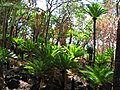 Cycas media
 -
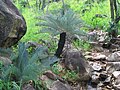 Cycas platyphylla with new flush of fronds


