Sebastes: Difference between revisions
CSV import Tags: mobile edit mobile web edit |
CSV import |
||
| Line 34: | Line 34: | ||
[[Category:Sebastidae]] | [[Category:Sebastidae]] | ||
{{fish-stub}} | {{fish-stub}} | ||
== Sebastes gallery == | |||
<gallery> | |||
File:Sebastes ruberrimus 1.jpg|Sebastes ruberrimus | |||
File:Red rockfish.jpg|Red rockfish | |||
File:Sebastes alutus.png|Sebastes alutus | |||
File:Sebastes atrovirens.jpg|Sebastes atrovirens | |||
File:Brown rockfish.jpg|Brown rockfish | |||
File:Sebastes aurora noaa.jpg|Sebastes aurora | |||
File:Sebastes babcocki.jpg|Sebastes babcocki | |||
File:Largest Shortraker Rockfish (Sebastes borealis) ever seen.jpg|Largest Shortraker Rockfish (Sebastes borealis) ever seen | |||
File:Sebastes carnatus.jpg|Sebastes carnatus | |||
File:Sebastes caurinus 1.jpg|Sebastes caurinus | |||
</gallery> | |||
Latest revision as of 05:46, 3 March 2025
Sebastes is a genus of fish in the family Sebastidae which is also known as the rockfishes. The genus is diverse and widespread, with species found in the Atlantic, Pacific and Indian Oceans.
Taxonomy[edit]
The genus Sebastes was first described by the French naturalist Bernard Germain de Lacépède in 1802. The name Sebastes comes from the Greek word 'sebastos', which means venerable or august. This genus is part of the family Sebastidae, which also includes the genera Sebastolobus and Adelosebastes.
Description[edit]
Sebastes species are characterized by their spiny dorsal fins, large pectoral fins, and a lateral line that extends to the end of the dorsal fin. They are typically brightly colored, with patterns and colors that vary widely between species. The size of Sebastes species can range from 20 cm to 100 cm in length, depending on the species.
Distribution and habitat[edit]
Sebastes species are found in the Atlantic, Pacific and Indian Oceans. They are typically found in rocky areas and reefs, and some species are known to inhabit deep-sea environments. Sebastes species are generally demersal, meaning they live close to the sea floor.
Diet[edit]
The diet of Sebastes species varies with age, size and species. Juveniles typically feed on plankton, while adults feed on a variety of organisms including crustaceans, mollusks, and smaller fish.
Reproduction[edit]
Sebastes species are ovoviviparous, meaning the eggs develop and hatch inside the mother's body. The young are then released as free-swimming larvae. This reproductive strategy is relatively rare among fish and gives Sebastes species a reproductive advantage in their often harsh and unpredictable habitats.
Conservation[edit]
Many Sebastes species are commercially important and are targeted by fisheries. Overfishing has led to population declines in some species, and several are now considered threatened or endangered. Conservation measures such as fishing quotas and marine protected areas have been implemented to protect Sebastes populations.
See also[edit]
- List of fish in the Pacific Ocean
- List of fish in the Atlantic Ocean
- List of fish in the Indian Ocean
Sebastes gallery[edit]
-
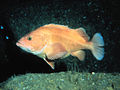 Sebastes ruberrimus
 -
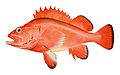 Red rockfish
 -
 Sebastes alutus
 -
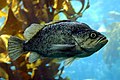 Sebastes atrovirens
 -
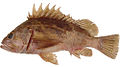 Brown rockfish
 -
 Sebastes aurora
 -
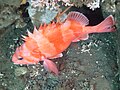 Sebastes babcocki
 -
 Largest Shortraker Rockfish (Sebastes borealis) ever seen
 -
 Sebastes carnatus
 -
 Sebastes caurinus


_ever_seen.jpg)


