Yitzhak Rabin: Difference between revisions
CSV import |
CSV import |
||
| (2 intermediate revisions by the same user not shown) | |||
| Line 1: | Line 1: | ||
'''Yitzhak Rabin''' ({{lang-he|יצחק רבין}}; March 1, 1922 – November 4, 1995) was an [[Israeli]] [[politician]] and [[military leader]]. He served as the [[Prime Minister of Israel]] from 1974 to 1977 and again from 1992 until his assassination in 1995. Rabin was awarded the [[Nobel Peace Prize]] in 1994 along with [[Shimon Peres]] and [[Yasser Arafat]] for their efforts in the [[Oslo Accords]]. | |||
== Early Life and Education == | |||
Rabin was born in [[Jerusalem]] during the [[British Mandate of Palestine]]. He was raised in a [[Zionist]] family and attended the [[Kadoorie Agricultural High School]]. Rabin later joined the [[Palmach]], the elite fighting force of the [[Haganah]], the underground army of the Jewish community in Palestine. | |||
== | == Military Career == | ||
Rabin | Rabin played a significant role in the [[1948 Arab-Israeli War]], serving as a brigade commander in the newly formed [[Israel Defense Forces]] (IDF). He rose through the ranks to become the IDF's Chief of Staff, overseeing the [[Six-Day War]] in 1967, which resulted in a decisive victory for Israel. | ||
== | == Political Career == | ||
Rabin joined the [[ | After retiring from the military, Rabin entered politics and joined the [[Israeli Labor Party]]. He was appointed as the [[Ambassador of Israel to the United States]] from 1968 to 1973. Rabin became the [[Prime Minister of Israel]] in 1974, following the resignation of [[Golda Meir]]. | ||
== | === First Term as Prime Minister === | ||
Rabin | During his first term, Rabin focused on strengthening Israel's economy and military. He also worked towards peace with Israel's neighbors, although his efforts were met with limited success. | ||
=== | === Second Term and the Oslo Accords === | ||
Rabin was re-elected as Prime Minister in 1992. His second term is most notable for the signing of the [[Oslo Accords]], a series of agreements with the [[Palestine Liberation Organization]] (PLO) aimed at achieving a peace settlement. These accords led to mutual recognition between Israel and the PLO and the establishment of the [[Palestinian Authority]]. | |||
== Assassination == | == Assassination == | ||
On 4 | On November 4, 1995, Rabin was assassinated by [[Yigal Amir]], a right-wing extremist opposed to the peace process. His death was a significant blow to the peace efforts in the region. | ||
== Legacy == | == Legacy == | ||
Rabin is remembered as a | Rabin is remembered as a leader who took significant steps towards peace in the [[Middle East]]. His efforts in the [[Oslo Accords]] and his vision for a peaceful resolution to the Israeli-Palestinian conflict have left a lasting impact on the region. | ||
== See | == See Also == | ||
* [[Oslo Accords]] | * [[Oslo Accords]] | ||
* [[Israeli Labor Party]] | * [[Israeli Labor Party]] | ||
* [[ | * [[Six-Day War]] | ||
* [[Nobel Peace Prize]] | |||
== External Links == | |||
* [https://www.knesset.gov.il/mk/eng/mk_eng.asp?mk_individual_id_t=1 Yitzhak Rabin] at the [[Knesset]] website | |||
{{nt}} | |||
{{DEFAULTSORT:Rabin, Yitzhak}} | |||
[[Category:1922 births]] | [[Category:1922 births]] | ||
[[Category:1995 deaths]] | [[Category:1995 deaths]] | ||
[[Category:Prime Ministers of Israel]] | [[Category:Prime Ministers of Israel]] | ||
[[Category:Israeli military leaders]] | |||
[[Category:Assassinated Israeli politicians]] | [[Category:Assassinated Israeli politicians]] | ||
[[Category:Nobel Peace Prize laureates]] | [[Category:Nobel Peace Prize laureates]] | ||
[[Category:People from Jerusalem]] | [[Category:People from Jerusalem]] | ||
<gallery> | |||
File:Yitzhak_Rabin_1994_Portrait_(3x4_cropped).jpg|Yitzhak Rabin 1994 Portrait | |||
File:Flickr_-_Israel_Defense_Forces_-_Life_of_Lt._Gen._Yitzhak_Rabin,_7th_IDF_Chief_of_Staff_in_photos_(19).jpg|Life of Lt. Gen. Yitzhak Rabin, 7th IDF Chief of Staff in photos | |||
File:YitzhakRabin1948.png|Yitzhak Rabin 1948 | |||
File:Altalena_off_Tel-Aviv_beach.jpg|Altalena off Tel-Aviv beach | |||
File:Members_of_Israeli_Delegation_to_Armistice_talks_in_Rhodes,_January_1949.jpg|Members of Israeli Delegation to Armistice talks in Rhodes, January 1949 | |||
File:Richard_Nixon_and_Yitzhak_Rabin.jpg|Richard Nixon and Yitzhak Rabin | |||
File:Yitzhak_Rabin_1973_D84-017.jpg|Yitzhak Rabin 1973 | |||
File:Rabin_and_Peres_visit_Israeli_MissleBoat_SQN_1975.jpg|Rabin and Peres visit Israeli Missile Boat SQN 1975 | |||
</gallery> | |||
Latest revision as of 00:53, 27 February 2025
Yitzhak Rabin (Hebrew: יצחק רבין
- March 1, 1922 – November 4, 1995) was an Israeli politician and military leader. He served as the Prime Minister of Israel from 1974 to 1977 and again from 1992 until his assassination in 1995. Rabin was awarded the Nobel Peace Prize in 1994 along with Shimon Peres and Yasser Arafat for their efforts in the Oslo Accords.
Early Life and Education[edit]
Rabin was born in Jerusalem during the British Mandate of Palestine. He was raised in a Zionist family and attended the Kadoorie Agricultural High School. Rabin later joined the Palmach, the elite fighting force of the Haganah, the underground army of the Jewish community in Palestine.
Military Career[edit]
Rabin played a significant role in the 1948 Arab-Israeli War, serving as a brigade commander in the newly formed Israel Defense Forces (IDF). He rose through the ranks to become the IDF's Chief of Staff, overseeing the Six-Day War in 1967, which resulted in a decisive victory for Israel.
Political Career[edit]
After retiring from the military, Rabin entered politics and joined the Israeli Labor Party. He was appointed as the Ambassador of Israel to the United States from 1968 to 1973. Rabin became the Prime Minister of Israel in 1974, following the resignation of Golda Meir.
First Term as Prime Minister[edit]
During his first term, Rabin focused on strengthening Israel's economy and military. He also worked towards peace with Israel's neighbors, although his efforts were met with limited success.
Second Term and the Oslo Accords[edit]
Rabin was re-elected as Prime Minister in 1992. His second term is most notable for the signing of the Oslo Accords, a series of agreements with the Palestine Liberation Organization (PLO) aimed at achieving a peace settlement. These accords led to mutual recognition between Israel and the PLO and the establishment of the Palestinian Authority.
Assassination[edit]
On November 4, 1995, Rabin was assassinated by Yigal Amir, a right-wing extremist opposed to the peace process. His death was a significant blow to the peace efforts in the region.
Legacy[edit]
Rabin is remembered as a leader who took significant steps towards peace in the Middle East. His efforts in the Oslo Accords and his vision for a peaceful resolution to the Israeli-Palestinian conflict have left a lasting impact on the region.
See Also[edit]
External Links[edit]
- Yitzhak Rabin at the Knesset website
-
 Yitzhak Rabin 1994 Portrait
 -
 Life of Lt. Gen. Yitzhak Rabin, 7th IDF Chief of Staff in photos
 -
 Yitzhak Rabin 1948
 -
 Altalena off Tel-Aviv beach
 -
 Members of Israeli Delegation to Armistice talks in Rhodes, January 1949
 -
 Richard Nixon and Yitzhak Rabin
 -
 Yitzhak Rabin 1973
 -
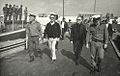 Rabin and Peres visit Israeli Missile Boat SQN 1975
.jpg)
.jpg)


