Brain asymmetry: Difference between revisions
CSV import |
CSV import |
||
| Line 31: | Line 31: | ||
{{anatomy-stub}} | {{anatomy-stub}} | ||
== Brain_asymmetry == | |||
<gallery> | |||
File:Brain_Lateralization.svg|Brain Lateralization | |||
File:Paul_Broca.jpg|Paul Broca | |||
</gallery> | |||
Latest revision as of 21:11, 25 February 2025
Brain Asymmetry refers to the differences in form and function between the two hemispheres of the brain. It is a fundamental aspect of neuroanatomy, neurobiology, and neuropsychology. Brain asymmetry is evident in the morphology, neurophysiology, and neurochemistry of the brain, and it is linked to lateralization of brain function.
Overview[edit]
The human brain is divided into two hemispheres, the left and the right, connected by a bundle of nerve fibers called the corpus callosum. While these two halves may appear symmetrical, they have functional and structural differences, a phenomenon known as brain asymmetry.
Structural Asymmetry[edit]
Structural asymmetry in the brain is evident in the different sizes and shapes of the brain's two hemispheres. For example, the planum temporale, an area involved in language processing, is typically larger in the left hemisphere than in the right. This asymmetry is thought to underlie the lateralization of language processing to the left hemisphere in most right-handed individuals.
Functional Asymmetry[edit]
Functional asymmetry refers to the differences in the cognitive functions that each hemisphere primarily controls. The left hemisphere, for example, is typically dominant for language and logical reasoning, while the right hemisphere is dominant for spatial abilities, face recognition, visual imagery, and music.
Factors Influencing Brain Asymmetry[edit]
Several factors can influence brain asymmetry, including genetics, sex, and age. For example, males tend to have a greater degree of brain asymmetry than females, and this difference is thought to be influenced by sex hormones. Age also influences brain asymmetry, with changes in asymmetry patterns observed across the lifespan.
Clinical Significance[edit]
Abnormalities in brain asymmetry have been associated with several neurological and psychiatric disorders, including schizophrenia, autism, dyslexia, and attention deficit hyperactivity disorder (ADHD).
See Also[edit]
References[edit]
<references />

Brain_asymmetry[edit]
-
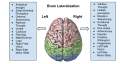 Brain Lateralization
 -
 Paul Broca


