Hoosier cabinet: Difference between revisions
CSV import |
CSV import |
||
| Line 29: | Line 29: | ||
[[Category:20th-century furniture]] | [[Category:20th-century furniture]] | ||
[[Category:History of the United States]] | [[Category:History of the United States]] | ||
== Hoosier cabinet == | |||
<gallery> | |||
File:Hoosier_Cabinet_in_original_condition.jpg|Hoosier Cabinet in original condition | |||
File:Sellers_Kitcheneed_Cabinet_1916.png|Sellers Kitcheneed Cabinet 1916 | |||
File:Kitchen_LCCN2016824204.jpg|Kitchen | |||
File:Sellers_Cabinet_ad_from_Richmond_Times-Dispatch_1921-05-01_Page_17.png|Sellers Cabinet ad from Richmond Times-Dispatch 1921-05-01 Page 17 | |||
File:Sneath_Glass_Kitchen_Booklet_2-3.jpg|Sneath Glass Kitchen Booklet 2-3 | |||
File:Sneath_Glass_Kitchen_Booklet_8-9.jpg|Sneath Glass Kitchen Booklet 8-9 | |||
File:Boone_Kitchen_Cabinets_logo.png|Boone Kitchen Cabinets logo | |||
File:Napanee_Dutch_Kitchenet_logo.png|Napanee Dutch Kitchenet logo | |||
</gallery> | |||
Latest revision as of 12:04, 25 February 2025

Hoosier cabinet is a type of cupboard or cabinet that became popular in the early 20th century in the United States. Named after the state of Indiana, known as the "Hoosier State," these cabinets were manufactured by several companies based in Indiana, which contributed to the name. The Hoosier cabinet is a freestanding kitchen cabinet that combines storage and a workspace, which was particularly useful before the modern kitchen with built-in cabinetry became common.
History[edit]
The Hoosier cabinet's origins can be traced back to the late 19th century, but it was during the 1910s and 1920s that they became a staple in American kitchens. Companies like the Hoosier Manufacturing Company, based in New Castle, Indiana, were among the most prominent makers. These cabinets were designed to save time and steps in the kitchen, incorporating various features such as flour sifters, spice racks, bread boxes, and ironing boards into one piece of furniture.
Design and Features[edit]
A typical Hoosier cabinet consists of three parts: the base, which includes drawers and large compartments; the countertop, which is often made of enamel or wood; and the upper hutch, which contains smaller compartments, shelves, and sometimes a roll-top or tambour doors. The design aimed to consolidate the many functions of the kitchen into one efficient piece of furniture. Some models included additional features like pull-out work surfaces, meat grinders, and even built-in clocks.
Materials and Construction[edit]
Early Hoosier cabinets were primarily constructed from oak, but as styles changed, manufacturers began to use other materials such as pine, maple, and enamel-coated metal. The use of enamel provided an easy-to-clean surface, which was a significant selling point for these cabinets.
Cultural Significance[edit]
The Hoosier cabinet reflects a significant shift in American domestic life, moving towards more efficient and organized kitchen spaces. It also represents the industrialization of household furniture production in the early 20th century. Today, Hoosier cabinets are considered collectible antiques, valued both for their historical significance and their practicality.
Preservation and Collection[edit]
Collectors and enthusiasts seek out original Hoosier cabinets, with particular interest in well-preserved examples that retain their original hardware and paint. The restoration of these cabinets often involves refinishing wood surfaces, repairing hardware, and sometimes replacing the enamel worktops.
In Popular Culture[edit]
The Hoosier cabinet has been featured in various forms of media, often evoking nostalgia for early 20th-century domestic life. It is seen as an icon of American design and ingenuity.
See Also[edit]
Hoosier cabinet[edit]
-
 Hoosier Cabinet in original condition
 -
 Sellers Kitcheneed Cabinet 1916
 -
 Kitchen
 -
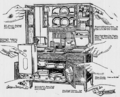 Sellers Cabinet ad from Richmond Times-Dispatch 1921-05-01 Page 17
 -
 Sneath Glass Kitchen Booklet 2-3
 -
 Sneath Glass Kitchen Booklet 8-9
 -
 Boone Kitchen Cabinets logo
 -
 Napanee Dutch Kitchenet logo


