Backhousia citriodora: Difference between revisions
CSV import Tags: mobile edit mobile web edit |
CSV import |
||
| Line 24: | Line 24: | ||
{{plant-stub}} | {{plant-stub}} | ||
{{food-stub}} | {{food-stub}} | ||
<gallery> | |||
File:Backhousia_citriodora.jpg|Backhousia citriodora | |||
File:Backhousia_citriodora_flowers_01.jpg|Backhousia citriodora flowers | |||
File:LemonMyrtleEssentialOil.png|Lemon Myrtle Essential Oil | |||
File:CSIRO_ScienceImage_4242_Dried_and_Crushed_Lemon_Myrtle_Leaves_Backhousia_citriodora.jpg|Dried and Crushed Lemon Myrtle Leaves | |||
</gallery> | |||
Latest revision as of 11:49, 25 February 2025
Backhousia citriodora is a flowering plant species that belongs to the family Myrtaceae. It is native to the subtropical rainforests of Queensland and New South Wales, Australia. The plant is commonly known as lemon myrtle due to its strong lemon scent, which is attributed to the high concentration of citral in its leaves.
Description[edit]
Backhousia citriodora is a medium-sized tree that can grow up to 20 meters in height. The leaves are lanceolate, 5-12 cm long and 1.5-2.5 cm wide, with a glossy green upper surface. The flowers are creamy-white and form in clusters at the ends of the branches.
Cultivation and Uses[edit]
Backhousia citriodora is cultivated for its leaves, which are used in foods, beverages, and essential oils. The leaves are often used as a lemon flavoring in tea, sauces, syrups, confectionery, and savory dishes. The essential oil extracted from the leaves is used in aromatherapy, perfumery, and as an antimicrobial agent.
Conservation Status[edit]
Backhousia citriodora is not considered to be at risk in the wild. However, due to its popularity in cultivation, there are concerns about over-harvesting from wild populations.
References[edit]
<references />
See Also[edit]


-
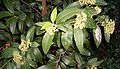 Backhousia citriodora
 -
 Backhousia citriodora flowers
 -
 Lemon Myrtle Essential Oil
 -
 Dried and Crushed Lemon Myrtle Leaves


