Bassia scoparia: Difference between revisions
CSV import Tags: mobile edit mobile web edit |
CSV import Tags: mobile edit mobile web edit |
||
| Line 21: | Line 21: | ||
[[Category:Amaranthaceae]] | [[Category:Amaranthaceae]] | ||
{{Amaranth-stub}} | {{Amaranth-stub}} | ||
== Bassia scoparia == | |||
<gallery> | |||
File:Kochia_aka_Fire_bush_7128.JPG|Kochia aka Fire bush | |||
File:Tonburi_Seed.JPG|Tonburi Seed | |||
File:Kochia_scoparia_(5129971536).jpg|Kochia scoparia | |||
File:Kochia_scoparia_(5129971714).jpg|Kochia scoparia | |||
File:Kochia_scoparia_(8161733508).jpg|Kochia scoparia | |||
File:Bassia_scoparia_in_Jardin_des_Plantes_001.jpg|Bassia scoparia in Jardin des Plantes | |||
File:Kochia_Hitachi_Seaside_Park.jpg|Kochia Hitachi Seaside Park | |||
</gallery> | |||
Latest revision as of 11:47, 25 February 2025
Bassia scoparia, also known as summer cypress, burning bush, ragweed, Mexican fireweed, or kochia, is a large annual herb in the family Amaranthaceae. It is native to Eurasia but is known worldwide as an introduced species and sometimes a noxious weed.
Description[edit]
Bassia scoparia is a hardy plant that can grow in many types of soil, from sandy to clay, and is resistant to drought. It can grow up to 2 meters tall with a deep taproot and a branching stem that is either erect or decumbent. The leaves are linear to lanceolate and the flowers are small, green and inconspicuous. The fruit is a small, flattened, single-seeded utricle.
Distribution and habitat[edit]
Bassia scoparia is native to Eurasia but has been introduced to many other parts of the world, including North America, South America, Australia, and Africa. It is often found in disturbed areas such as roadsides, fields, and waste places. It can also grow in a variety of natural habitats, from deserts to wetlands.
Uses[edit]
Bassia scoparia has been used for various purposes throughout history. It has been used as a forage plant for livestock, and its seeds have been used as a food source in times of famine. It has also been used in traditional medicine to treat various ailments, and its ashes have been used as a soap substitute. However, it can also be a problematic weed in some areas, outcompeting native plants and altering ecosystems.
Cultivation[edit]
Bassia scoparia is a fast-growing plant that can be easily grown from seed. It prefers full sun and well-drained soil, but can tolerate a wide range of soil types and conditions. It is often used as an ornamental plant for its attractive fall color, but care should be taken to prevent it from spreading uncontrollably.
See also[edit]
This Amaranth-related article is a stub. You can help WikiMD by expanding it.
Bassia scoparia[edit]
-
 Kochia aka Fire bush
 -
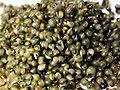 Tonburi Seed
 -
 Kochia scoparia
 -
 Kochia scoparia
 -
 Kochia scoparia
 -
 Bassia scoparia in Jardin des Plantes
 -
 Kochia Hitachi Seaside Park


.jpg)
.jpg)
.jpg)


